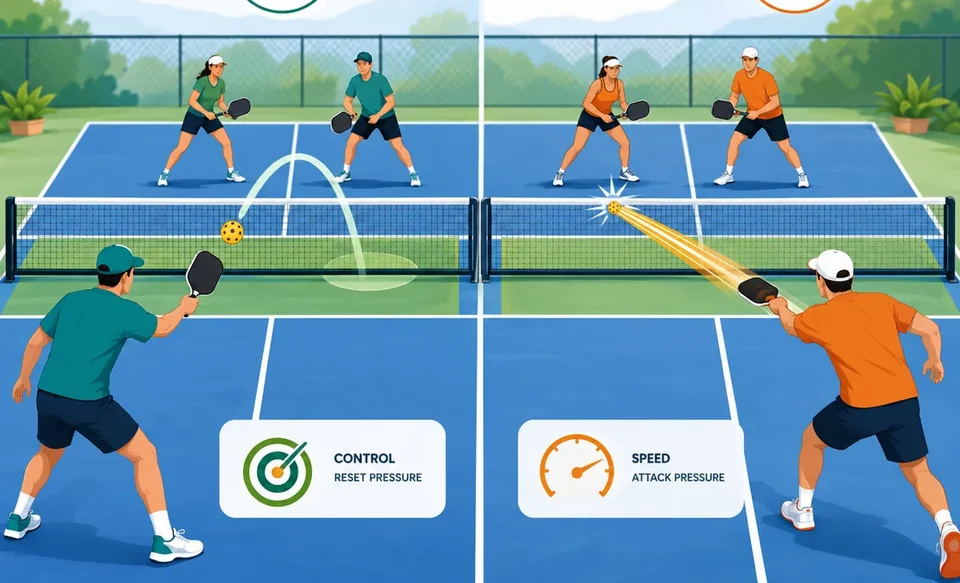
A slightly slower return you can follow may beat a faster return that leaves you stuck.
What the return has to accomplish
The return must land in court and leave you prepared for the third shot. Depth can keep the serving team farther from the kitchen, while flight time can help you move forward. Those benefits disappear if you chase the baseline with no margin and miss. Begin by picking a large deep target, not the final few inches of the court.
Pace and height are tools. A low, fast return may pressure an opponent, but it also comes back quickly. A higher, controlled return may buy time, but a short floater can invite an aggressive third. Judge the combination of depth and recovery, rather than treating “low” or “hard” as an independent success measure.
Do not start running before finishing contact
Meet the serve with your feet organized enough to control the face. Finish contact, then move. If you are pulled wide, recovery may initially be sideways rather than forward. Running toward the kitchen while your body is still reaching for the serve often produces a short return and an awkward next ball.
As the serving team contacts the third shot, prepare to respond even if you have not reached the line. Arriving at the kitchen late but balanced is not ideal, yet it is usually a more workable starting point than being mid-stride on a drive to your feet. Your partner can help by avoiding an unnecessary gap and communicating the ball.
Choose targets with a team-level purpose
A middle return reduces the sideline you must protect and can make the serving team decide who takes the ball. A return to a weaker backhand can work, but only when the target is large enough for your accuracy. A very wide return changes the available angles for the third shot. Ask what the opponent can do next, not only whether you reached the intended side.
Spin is optional. A slice that stays deep may be useful; a slice that repeatedly dies short is not better just because it looks sophisticated. Compare it with a simpler return over the same set of serves. Keep the stroke that most consistently gives your team a playable third-ball situation.
A useful return scorecard
For 20 returns, track only three things: in or out, deep or short, and balanced or moving at the third contact. Mark whether a miss came from late footwork, a tiny target or too much pace. That gives you a specific practice task instead of the vague conclusion that your return is bad. Repeat the same exercise with the same ball and partner before adding equipment changes.
Try it, then record it.
Return 20 serves toward a generous deep-middle target. A successful repetition requires both an in-court return and readiness at the third-shot contact.
Open your worksheetPicklary practical framework. Practice targets are suggestions, not research findings or a certified rating.