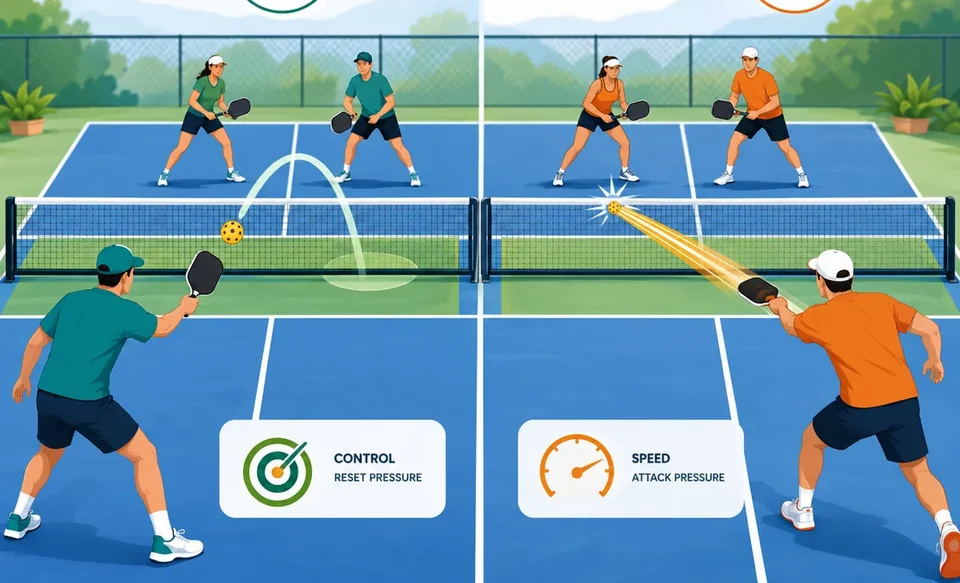
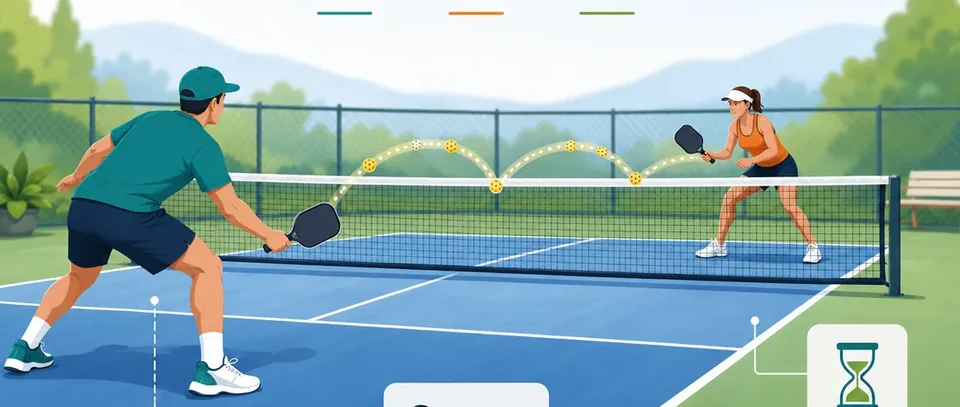
Move between contacts. Be ready at contact.
Why a soft hand still sends the ball high
You can use a gentle grip and still pop the ball up if your body is moving through contact. The paddle is only one part of the collision. A lunging torso, a late step or an upward shoulder lift can add the energy you were trying to remove. Before changing your grip again, review a few clips and freeze the frame at your opponent’s strike.
Look for a base that allows a small adjustment in either direction. A split step is preparation, not a large vertical jump. Land ready to respond rather than still descending when the ball reaches you. The useful timing varies with distance and speed; aim for readiness, not a fixed dance step on every ball.
Give the paddle a smaller job
On a fast ball arriving below net height, begin by trying to take pace off rather than lifting aggressively. Keep the contact in front when possible and use the face angle to create enough height to clear the net. A reset is allowed to travel upward; what matters is whether it then becomes attackable. Avoid treating “low over the net” as a demand to miss into the tape.
Use the larger cross-court or middle area when you need margin. A narrow sideline reset asks for precision when you are least balanced. If you can only reach the ball late, a controlled defensive lift may be preferable to forcing an impossible soft angle. A reset is a tool for regaining a neutral point, not a beauty contest.
Advance only as far as the next ball allows
After a reset lands safely, take the ground that is available and prepare again. Do not turn a decent reset into an unbalanced next contact by sprinting toward the line. Partners can progress together in small increments. When one player is pinned back, leaving a huge depth gap often gives opponents an easier angle through the team.
Agree on a short communication cue such as “hold” or “up.” Use it to share the situation, not to criticize a partner during the point. Communication is most useful before the next collision, while there is still time to adjust. Discuss the pattern between games if the same depth gap keeps appearing.
A progression with a clear stopping point
Start stationary around the middle of the transition area and reset moderate feeds. Next, begin one step farther back and move only after your reset. Finally, randomize the feed direction. Count balanced contacts as well as successful balls. End or reduce speed if you start lunging repeatedly; otherwise you are rehearsing the failure rather than the solution.
Try it, then record it.
Three rounds of 10 feeds: stationary, one-step approach, random direction. Mark B for balanced and U for unbalanced before checking whether the ball landed in.
Open your worksheetPicklary practical framework. Practice targets are suggestions, not research findings or a certified rating.