He does not wait for the left player to create every attack.
Bolivia / United States tour scene
Gabriel Tardio
Explosive right-side pressure, fast hands, and fearless transition attacks

PLAYER STORYLINE
Why this player matters now
Tardio is redefining what a right-side player can contribute to an elite men’s doubles team.
Verified snapshot2026-07-22
Men’s doubles#1 · 21,800 points · DUPR 6.923
Men’s doubles medals24 gold · 6 silver
Mixed doubles#6 · 7,200 points
His backhand counter closes the middle before opponents can widen the point.
He attacks from locations many players treat only as survival zones.
TIMELINE
Career and storyline timeline
- Bolivian-born prospect moved quickly through the U.S. professional scene.
- Pairing with Ben Johns elevated both results and tactical visibility.
- No. 1-level men’s doubles profile and repeated championship results.
PARTNERSHIPS
Roles and chemistry
- Ben JohnsPoint structure + right-side acceleration
NEXT WATCH
What to follow next
Can opponents force him to play one extra soft ball before the counter window appears?
Right-side permissionRight-side player must initiate at least one safe attack every three rallies.
PLAYER × PADDLE
How the equipment fits the playing style
Equipment does not create a pro game, but shape, core and balance can support the patterns a player repeats most.
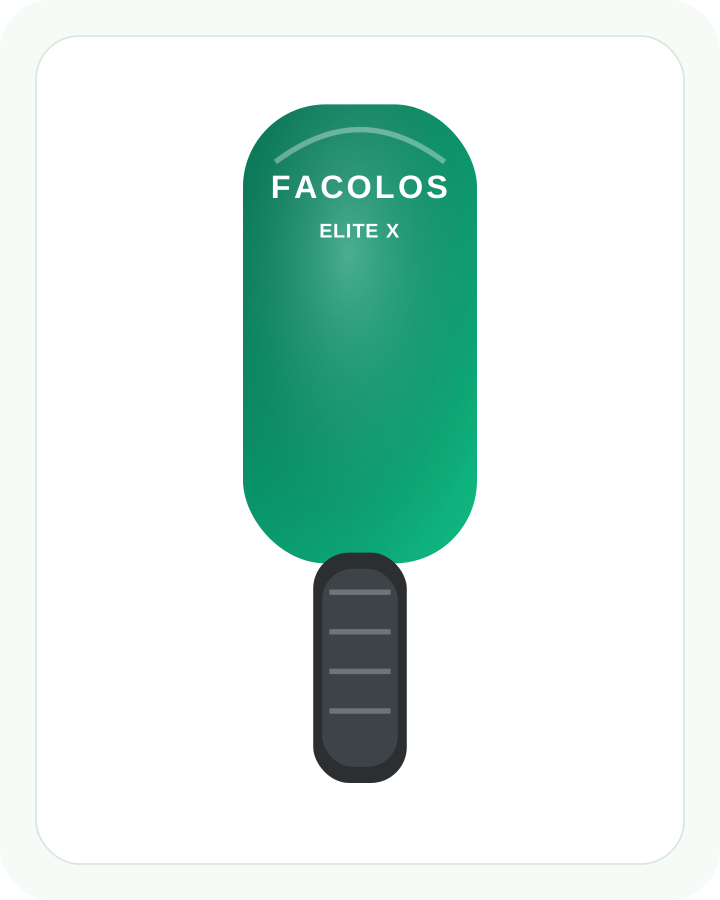
Official
Facolos Elite X V2 Gabe Tardio Signature
Official signature development platform; approval varies by edition
low balancespincounter speedstability
Why it fits
A lower balance point and wider effective sweet spot match his high-hand grip, compact backhand counters, and ability to redirect pace through the middle.
Club-player takeaway
His unusual grip and timing are personal; copy the early read, not the grip blindly.
Match-day equipment can change. The verification date and source are shown so readers can distinguish a signature model from reported or evolving use.
Biography
Gabriel Tardio’s rise is one of the clearest examples of the modern right-side doubles role becoming an attacking position rather than a passive support role. His compact two-handed backhand, willingness to counter through the middle, and ability to accelerate from the transition zone make him a valuable study for ambitious doubles players. His partnership with Ben Johns also creates a useful contrast: Johns organizes the point while Tardio compresses time and space.
Major skills
Right-side speed-upsTwo-handed backhand countersTransition aggressionMiddle pressurePartner role clarity
Career notes
- PPA men’s doubles No. 1 level profile in 2026.
- Multiple men’s doubles titles with Ben Johns.
- Known for converting defense into offense unusually early in the transition zone.
Events
Men’s doublesMixed doublesSingles
What to study
Track how he protects the middle, then attacks the first ball that rises above net height.
What club players can learn
Three things to study in Gabriel Tardio's game: Right-side speed-ups, Two-handed backhand counters, Transition aggression. Watching how a top professional applies these in live points is one of the fastest ways to add the same patterns to your own play.
Takeaways for 3.0–4.0 club players
This profile is not only a biography. It is a study note for deciding what to watch in Gabriel Tardio's game. Most club players cannot copy pro speed or athleticism, but they can copy the timing, spacing, and risk choices behind the point.
Start with Right-side speed-ups. Level improvement often begins with knowing which ball can be attacked and which ball should be kept low. Then watch Two-handed backhand counters. Good players usually win the next shot before it arrives because their court position is already prepared.
Finally, study Transition aggression. In pressure points, elite players often choose repeatable pressure over low-percentage winners. Read the profile with that lens and it becomes a practical training guide rather than just a player page.
- Copy: ready position, court spacing, low resets.
- Avoid copying: pro-level attacks that your current consistency cannot support.
- Practice link: choose one pattern and repeat it with a partner for ten minutes.
Live sources
Prices, sponsors, rankings, DUPR, and product availability change. Verify on the linked official source before publishing buying advice.
DUPR (check official source)
DUPR changes every time results are processed. Instead of pinning a number, Picklary links straight to Gabriel Tardio’s profile with their current DUPR and rankings.
| Hometown / base | Bolivia / U.S. professional circuit |
|---|---|
| Age | — |
| Height | — |
| Turned pro | Early 2020s |
| Plays | Right-handed |
| Resides | United States tour scene |
Image note: Original illustrated profile card. Not a photograph.