How a pickleball tournament works: formats and brackets
A newcomer-friendly explainer of tournament divisions, common formats, and how brackets decide medals.
For advanced players who need fewer loose points and better opponent-specific plans.
Precise paddle matched to personal style: power only if control stays intact.
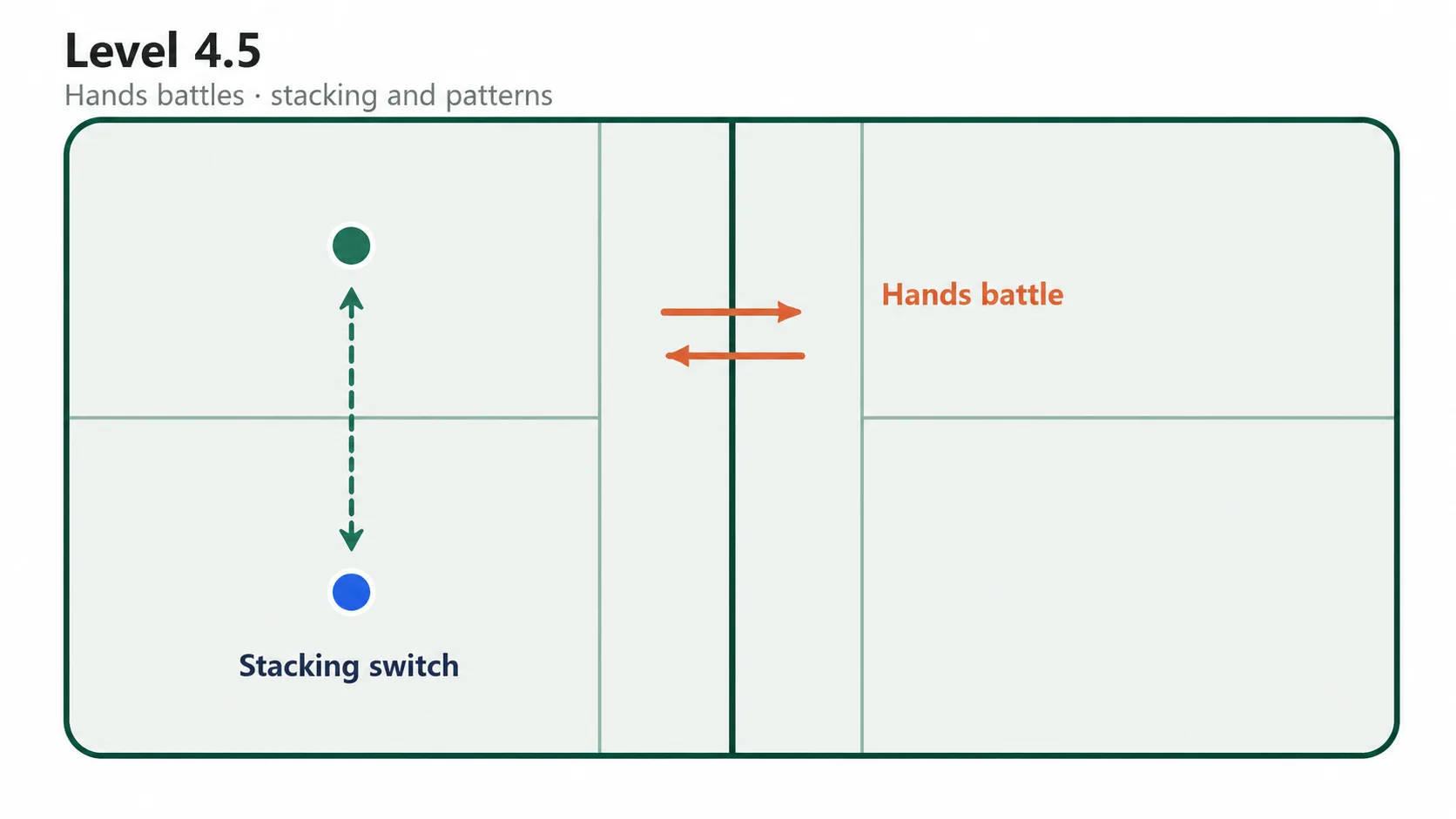
Pick a shot to see how the ball moves in an original court diagram, plus how to hit it and what it does.
How to hit it: Brush up and over a low ball at the net with a controlled topspin punch.
What it does: Roll volleys attack balls below the net height you can’t flat-drive.
How to hit it: Hold your dink posture, then flick at the body with no backswing tell.
What it does: Hidden speed-ups beat fast hands because they’re unexpected.
How to hit it: Stay compact at the net and win the hands battle by resetting your paddle fast.
What it does: At 4.5, points are decided in quick exchanges right at the line.
How to hit it: Disguise it as a dink, then lift it over the net player’s backhand shoulder.
What it does: A timed lob breaks a stalemate and pushes opponents off the net.
A newcomer-friendly explainer of tournament divisions, common formats, and how brackets decide medals.
How partners should move together, and a plain explanation of stacking.
Where to find official players, rankings, and results worldwide — and how to read them without relying on numbers that change week to week.
For advanced players who need fewer loose points and better opponent-specific plans. Typical skills at this level: Scouting notes, Serve-return placement, Low-error pressure.
To reach 5.0, work on: Scout opponent patterns quickly; Protect your weakest ball under stress. A good drill is One-weakness protection games.
4.5 is generally considered an advanced level on the 2.0–5.0 scale. Note this is a self-assessment guide, not an official DUPR rating.