How to follow the global scene and find official rankings
Where to find official players, rankings, and results worldwide — and how to read them without relying on numbers that change week to week.
For highly competitive players studying pro-level decision trees and match plans.
Performance paddle chosen by exact play style, tournament approval status, and comfort over long matches.
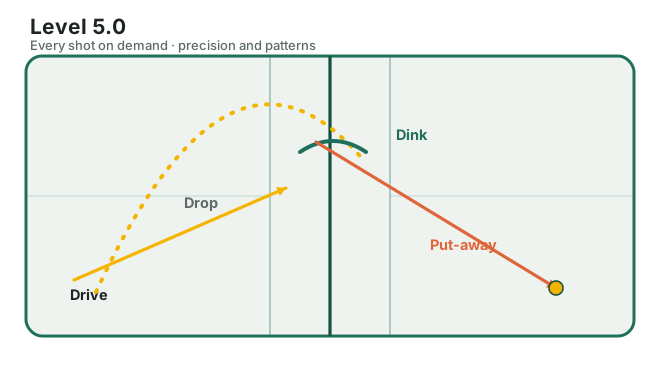
Pick a shot to see how the ball moves in an original court diagram, plus how to hit it and what it does.
How to hit it: Use an identical setup, then choose drop or drive late to freeze the opponent.
What it does: Disguise removes the opponent’s reaction time almost entirely.
How to hit it: Jump around the kitchen to take a wide ball out of the air beside the post.
What it does: The Erne ends points and pressures opponents away from the sideline.
How to hit it: On a very wide ball, let it drift outside the post and drive it around — no height limit.
What it does: The ATP turns a defensive wide ball into an outright winner.
How to hit it: Mix firm counters with soft re-resets to break the opponent’s timing.
What it does: Controlling tempo is the final layer of elite net play.
Where to find official players, rankings, and results worldwide — and how to read them without relying on numbers that change week to week.
How partners should move together, and a plain explanation of stacking.
What the third-shot drop is, when to use it versus a drive, and how to practise it.
For highly competitive players studying pro-level decision trees and match plans. Typical skills at this level: Pro pattern study, Counter-disguise, Advanced partner systems.
At 5.0 the fundamentals are complete; the gap to touring pros is mostly consistency under pressure, hand speed, and shot selection at full pace.
5.0 is generally considered an advanced level on the 2.0–5.0 scale. Note this is a self-assessment guide, not an official DUPR rating.