Level 2.0: New Player Foundation
A starter path for players who are still learning the rules, the kitchen, and basic ball control.
Serve and return basicsReady positionTwo-bounce rule
DUPR pathway 2.0–5.0
Select from 2.0 to 5.0 to get level-matched skills, drills, paddle profile, and recommended guides.
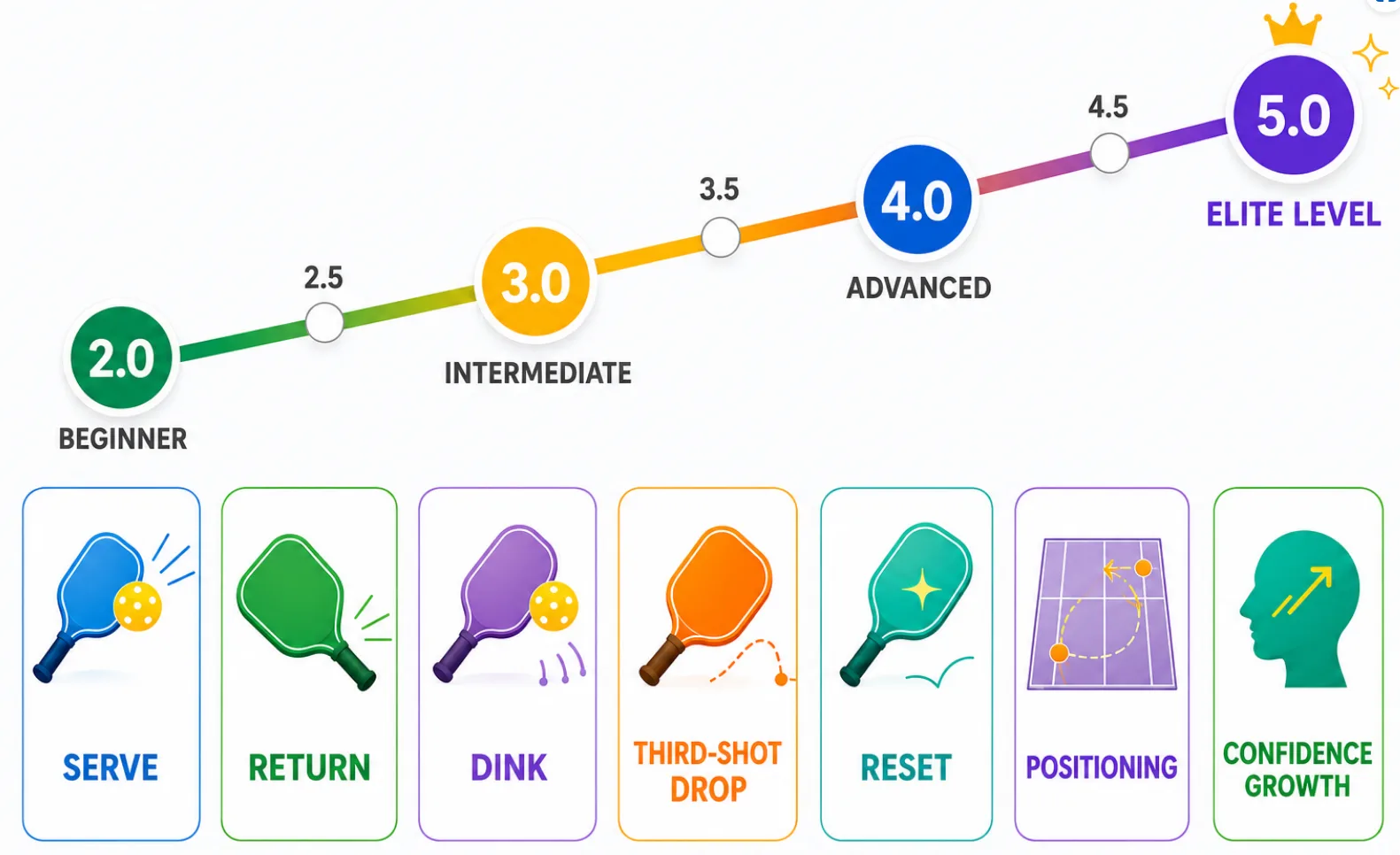
A starter path for players who are still learning the rules, the kitchen, and basic ball control.
A bridge from beginner rules knowledge to reliable rally construction.
For players who can rally but need structure to win more points instead of just keeping the ball alive.
For players ready to convert neutral rallies into advantages with smarter patterns.
A competitive level where shot quality, recovery, and tactical discipline matter on every rally.
For advanced players who need fewer loose points and better opponent-specific plans.
For highly competitive players studying pro-level decision trees and match plans.
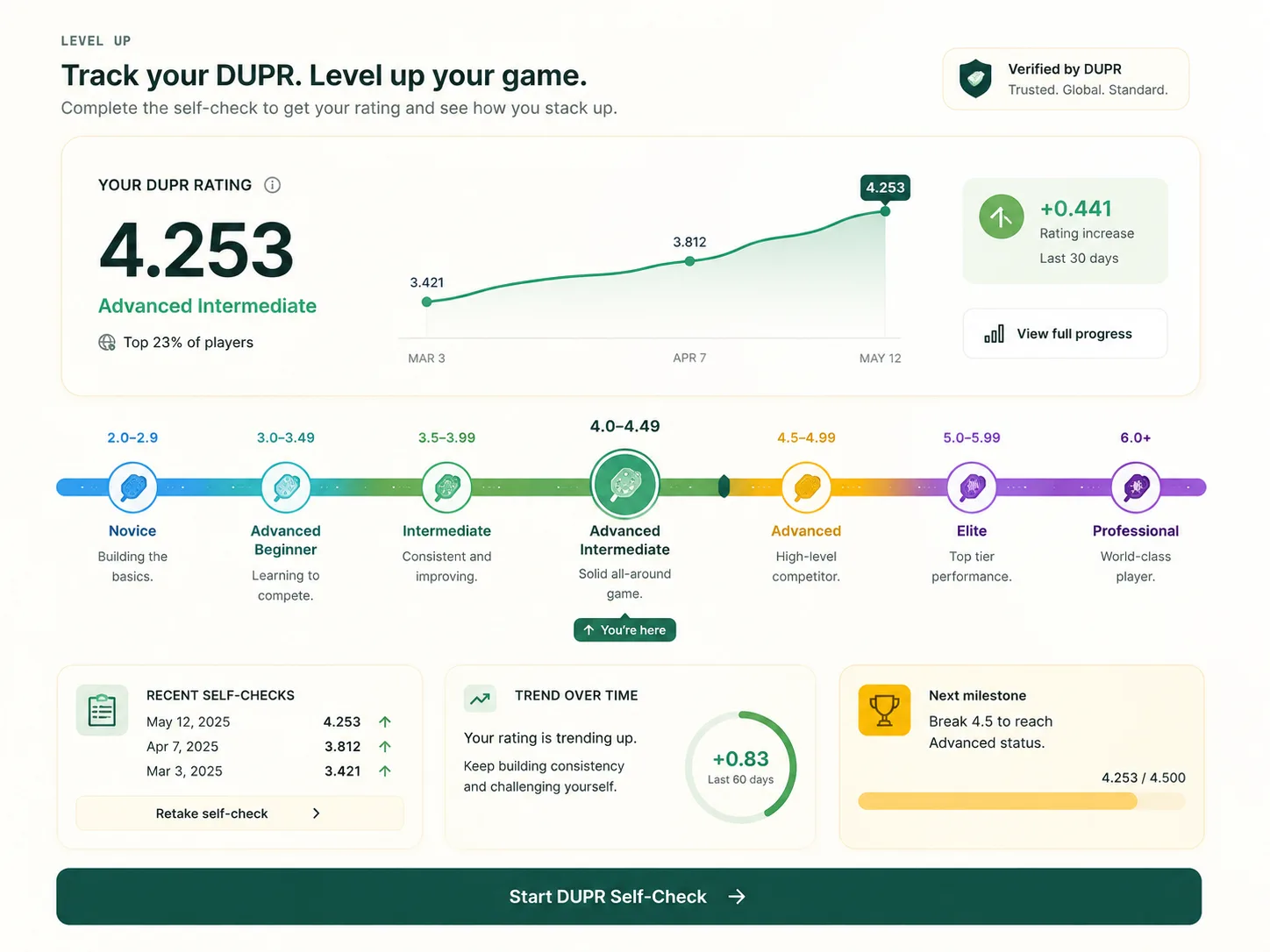
Levels are a useful shorthand for skill, but they are general descriptions, not official cut-offs. The real, portable rating is DUPR, calculated from your logged matches. Use the bands below to orient yourself, then confirm with a self-check and real matches. What is DUPR?
The jump is not about hitting harder; it is about doing the right thing more often. A 3.5 player keeps dinks low under pressure, has a dependable third-shot drop, resets fast balls instead of popping them up, and simply misses less. What a 3.0 player looks like · 3.0 to 3.5 plan
At 4.0 the shots are already there; what changes is patience, reliable resets, deliberate targeting, a drop-and-drive mix, and a team plan. The 3.5-to-4.0 jump is mostly about unlearning a few habits. 3.5 to 4.0: habits to fix
PICKLARY EDITORIAL
A label such as 2.0, 3.0, or 4.0 is only a starting point. Match level becomes clearer when a player can repeat the same skill under pace, choose when not to attack, and move with a partner to shrink open court.
That is why Picklary level guides emphasize repeatability and decisions rather than a checklist of shots. Hitting one good third-shot drop is different from reading return depth and choosing intelligently between a drop and a drive.
The self-check is not an official DUPR replacement. It is most useful as a training checklist for the next few weeks, especially when you can compare your answers with actual match video.