Doubles positioning basics: when (and why) to stack
How partners should move together, and a plain explanation of stacking.
A competitive level where shot quality, recovery, and tactical discipline matter on every rally.
Stable all-court or control-power hybrid that stays solid on counters.
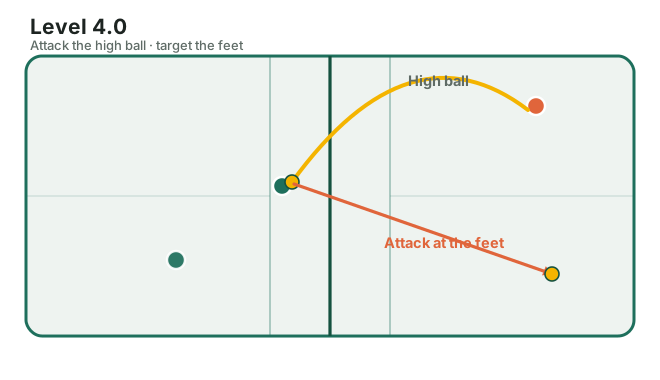
Pick a shot to see how the ball moves in an original court diagram, plus how to hit it and what it does.
How to hit it: Swing aggressively low-to-high, brushing up the back of the ball for dipping pace.
What it does: Topspin drives dip at the opponent’s feet and set up the next ball.
How to hit it: Keep a compact, firm punch and redirect the opponent’s speed-up back at them.
What it does: Strong counters make opponents pay for attacking first.
How to hit it: Pull them off court with angled dinks, then accelerate the moment one pops up.
What it does: Patient pressure creates the high ball you can attack.
How to hit it: Soften the grip, meet the ball early, and drop fast hands into the kitchen.
What it does: Resetting hard drives keeps you alive in long, advanced rallies.
How partners should move together, and a plain explanation of stacking.
What the third-shot drop is, when to use it versus a drive, and how to practise it.
A newcomer-friendly explainer of tournament divisions, common formats, and how brackets decide medals.
A competitive level where shot quality, recovery, and tactical discipline matter on every rally. Typical skills at this level: Pressure resets, Counter exchanges, Drive-plus-drop patterns.
To reach 4.5, work on: Reset under pressure; Counter speed-ups without over-swinging. A good drill is Two-ball reset ladder.
4.0 is generally considered an advanced level on the 2.0–5.0 scale. Note this is a self-assessment guide, not an official DUPR rating.