Dinking fundamentals: staying steady at the kitchen line
What a good dink looks like, the technique behind it, and how to practise patience at the net.
For players ready to convert neutral rallies into advantages with smarter patterns.
Control or spin-focused paddle that rewards placement and quick hands.
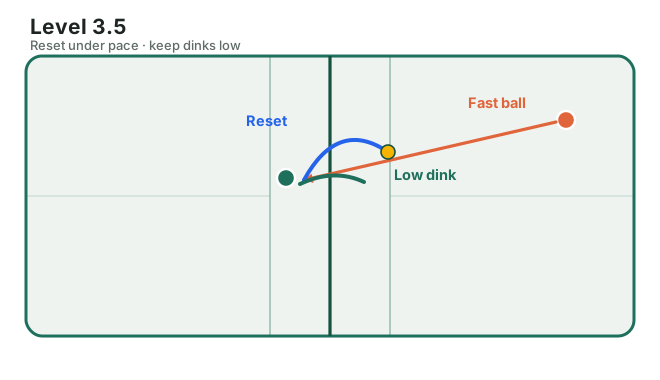
Pick a shot to see how the ball moves in an original court diagram, plus how to hit it and what it does.
How to hit it: Repeat the same soft low-to-high motion under pressure, landing it at the kitchen line.
What it does: Consistency on this shot is what separates 3.5 from 3.0.
How to hit it: Drive the third low and hard, then drop the fifth soft if it comes back.
What it does: Mixing drive and drop keeps the net team guessing and off balance.
How to hit it: When a dink floats up, flick it firmly at the opponent’s shoulder or hip.
What it does: Punishing loose dinks forces errors and opens up the net.
How to hit it: Bend your knees, paddle in front, and cushion the ball softly into the kitchen.
What it does: Calm resets get you out of trouble and back onto offense.
What a good dink looks like, the technique behind it, and how to practise patience at the net.
What the third-shot drop is, when to use it versus a drive, and how to practise it.
How partners should move together, and a plain explanation of stacking.
For players ready to convert neutral rallies into advantages with smarter patterns. Typical skills at this level: Dink patterns, Speed-up selection, Counter blocks.
To reach 4.0, work on: Create pressure without rushing; Use speed-ups only when the ball is attackable. A good drill is Three-dink pattern drill.
3.5 is generally considered an intermediate level on the 2.0–5.0 scale. Note this is a self-assessment guide, not an official DUPR rating.