Serve and return basics: common mistakes and fixes
Simple ways to make your serve and return consistent and deep.
A bridge from beginner rules knowledge to reliable rally construction.
Control or all-court paddle with enough forgiveness to protect consistency.
Pick a shot to see how the ball moves in an original court diagram, plus how to hit it and what it does.
How to hit it: Get sideways, keep the paddle face stable, and push through the ball toward a target.
What it does: A trustworthy backhand removes a common weakness opponents love to attack.
How to hit it: At the net, hold a firm wrist and let the ball rebound off a still paddle.
What it does: Blocking turns hard incoming shots into soft balls you can control.
How to hit it: Aim diagonally over the lowest part of the net into the far kitchen corner.
What it does: Cross-court dinks have more room and are harder for opponents to attack.
How to hit it: From the baseline, swing softly low-to-high so the ball arcs down into the kitchen.
What it does: Getting the third shot soft lets your team move up to the net together.
Simple ways to make your serve and return consistent and deep.
What a good dink looks like, the technique behind it, and how to practise patience at the net.
Paddle stacks, calling lines, and the etiquette of rotating in at busy courts.
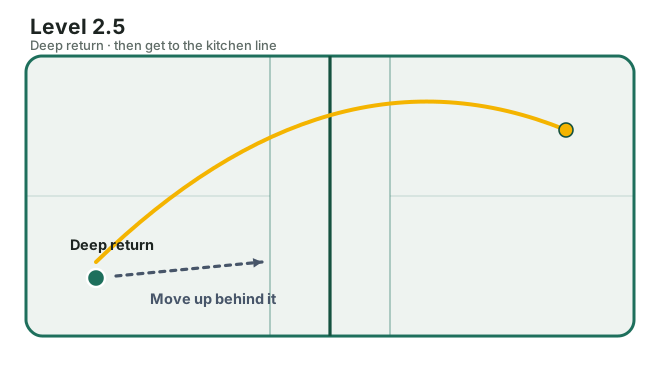
A bridge from beginner rules knowledge to reliable rally construction. Typical skills at this level: Deep returns, Basic dinks, Early split step.
To reach 3.0, work on: Make more returns deep; Dink without popping the ball up. A good drill is Deep return ladder.
2.5 is generally considered a beginner level on the 2.0–5.0 scale. Note this is a self-assessment guide, not an official DUPR rating.