Control vs power paddles: which one suits you
Every paddle sits somewhere on a control-to-power spectrum.
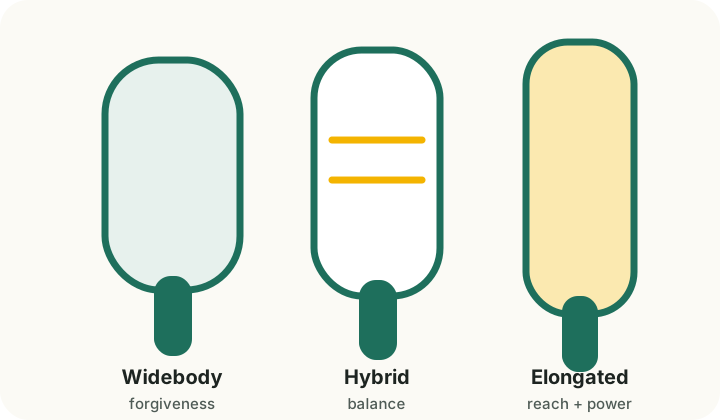
Paddles are often described as "control" or "power," but really every paddle sits somewhere on a spectrum between the two. Understanding what pushes a paddle toward one end helps you choose one that supports how you actually play instead of fighting it. Here is what separates the two, the trade-offs, and how to pick your side.
What makes a paddle power-oriented
A power paddle springs the ball back with extra pace. That usually comes from a thinner core, a stiffer or flexier face that pops, a heavier or more head-heavy build, and sometimes an elongated shape. The upside is easy put-aways, strong drives, and deep serves with less effort. The trade-off is that power paddles are harder to control on touch shots — dinks and resets tend to fly or pop up — they are less forgiving on off-centre hits, and they can put more strain on your arm.
What makes a paddle control-oriented
A control paddle is built for touch and consistency. A thicker core (around 16 mm) plays softer and absorbs pace, a raw carbon face grips the ball for spin and predictability, and a balanced shape gives a larger, more forgiving sweet spot. The upside is dependable dinks, drops, and resets, easier spin, and forgiveness when you mishit. The trade-off is that you supply more of your own power, so put-aways take more deliberate technique.
Weight and swing weight
How a paddle feels in motion matters as much as the number on the scale. A head-heavy paddle hits with more power but is slower to maneuver, while a more balanced or head-light paddle is quicker at the net for fast hands and resets. If a paddle feels sluggish in a quick exchange, its swing weight is probably too high for you, regardless of the static weight.
Who should pick which
Most beginners and anyone who lives in the soft game — dinkers, droppers, and players who win with patience and placement — are better served by a control-leaning paddle. Players who supply their own power, hit a lot of drives, or play singles may prefer something further toward the power end. Modern recreational doubles, where the soft game decides points, has trended strongly toward control-and-spin paddles for exactly this reason.
How to decide for yourself
Start from your style and your body. If you tend to overhit and miss, lean control; if you struggle to put balls away or end points, lean a little toward power. If your elbow or shoulder gets sore, a lighter, softer control paddle is kinder. Whenever you can, demo a paddle from each end of the spectrum and feel the difference. Our guides to paddle face materials and choosing your first paddle cover the specifics that drive feel.
The bottom line
There is no universally "best" side — only the side that fits your game. Match the paddle to how you win points and how your arm feels, and you will spend your time improving rather than compensating for the wrong tool.
Common beginner mistakes
- Buying a power paddle then struggling to control dinks and resets.
- Judging a paddle by static weight alone and ignoring swing weight.
- Choosing power when your real problem is overhitting and errors.
- Ignoring arm comfort when picking a heavier, stiffer paddle.
Quick checklist
- Decide whether you overhit (lean control) or struggle to finish (lean power)
- Check swing weight, not just the number on the scale
- Prefer a thicker control core if you live in the soft game
- Factor in elbow and shoulder comfort
- Demo a paddle from each end before deciding
Frequently asked
Is a control or power paddle better for beginners?
Usually control. A thicker-core, control-leaning paddle is more forgiving, makes dinks and resets easier, and is gentler on the arm while you build technique.
What gives a paddle more power?
A thinner core, a poppy or stiffer face, and a heavier or more head-heavy build, sometimes in an elongated shape. These add pace but reduce touch and forgiveness.
Does swing weight matter?
Yes. A paddle can feel slow even at a low static weight if its weight is concentrated in the head. Quick hands at the net favour a more balanced swing weight.
Why do most doubles players choose control?
Because rec doubles is decided by the soft game — dinks, resets, and drops — where control and spin matter more than raw power.