How a pickleball tournament works: formats and brackets
What to expect at your first event, from divisions to medal matches.
Your first pickleball tournament feels confusing from the outside: brackets, divisions, pool play, medal matches, and a schedule that seems to assume you already know how it all fits together. It is simpler than it looks. Here is how a typical tournament is organised, how the formats work, and how to choose the right division so your first event is fun instead of overwhelming.
Divisions: how players are grouped
Tournaments split players into divisions so you compete against people at a similar level and stage of life. Divisions are usually defined two ways: by age bracket (for example 19+, 35+, 50+, 65+) and by skill level (often 3.0, 3.5, 4.0, and so on, or by DUPR rating). You also choose an event type — men's or women's singles, men's or women's doubles, and mixed doubles. You can often enter more than one event, such as a doubles division and a mixed division, on different days.
The two main formats
Most divisions run in one of two formats. In round robin, everyone in a small group plays everyone else, and final standings come from win-loss records; this guarantees you several matches even if you lose early. In single or double elimination, you advance through a bracket — single elimination sends you home after one loss, while double elimination gives you a second life in a "back draw" (the consolation bracket) so one bad match does not end your day. Larger events often combine them: a round-robin pool play stage seeds players into an elimination bracket.
Medal matches
In elimination formats, the bracket narrows to a gold-medal match between the two finalists, and usually a bronze-medal match for third place. In double elimination, the team coming up through the back draw may have to beat the unbeaten team twice to win gold, since that team has not lost yet — a quirk worth knowing before you are surprised by it on the day.
Scoring in tournaments
Most tournament matches are played to 11 points, win by 2, exactly like recreational games. Important matches — medal rounds especially — are often best-of-three games, and some events use games to 15. The format for your division is published in advance, so check it so you can pace yourself; a best-of-three medal match is a very different physical test from a single game to 11.
Sanctioned vs unsanctioned events
Events are either sanctioned by a governing body or run independently. Sanctioned tournaments follow standardised rules and equipment requirements and often feed results into rating systems, which matters if you care about an official record. Unsanctioned and club events are usually more relaxed and a great place to start. Either way, read the event's rules page so you know the ball being used, the format, and any equipment requirements before you arrive.
Choosing the right division
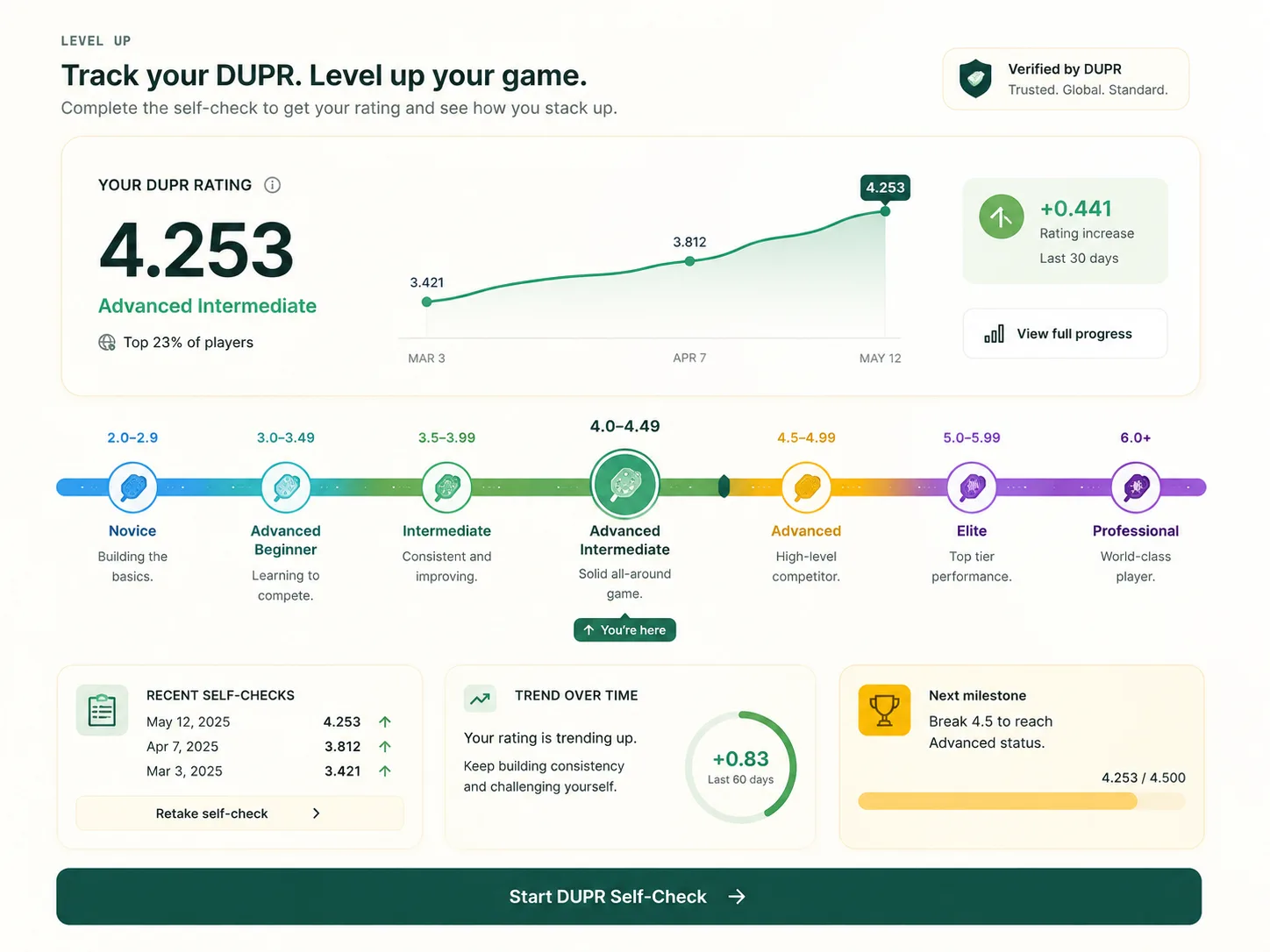
Pick the division that matches your honest level. It is tempting to enter low to win medals, but "sandbagging" — playing well below your real ability — makes for lopsided, unfun matches and is discouraged everywhere. If you are unsure, enter at your DUPR or self-rated level and treat your first event as a benchmark. You will learn more from competitive losses than from easy wins.
What to expect on the day
Arrive early, check in at the registration desk, and find the schedule board or app that lists your court assignments and times. Warm up before your first match, bring more water and food than you think you need, and expect downtime between rounds. Matches are usually self-officiated until the later rounds, so brush up on the basics in our rules guide, especially line calls and the score-calling sequence. Above all, treat your first tournament as a learning experience — the nerves fade fast once the first serve goes in.
Common beginner mistakes
- Entering a division well below your real level to chase medals.
- Not checking the format, so a best-of-three medal match catches you unprepared.
- Under-packing on water, food, and rest between rounds.
- Forgetting that early-round matches are usually self-officiated.
Quick checklist
- Choose age/skill division and event type honestly
- Read the event rules page (ball, format, equipment)
- Arrive early and check in; find your court schedule
- Warm up; bring extra water and snacks
- Review line calls and the score-calling sequence
Frequently asked
What is the difference between single and double elimination?
In single elimination one loss ends your event. In double elimination you drop into a back (consolation) draw after a loss and can keep playing, so it takes two losses to be out.
Why might the finalist have to win twice?
In double elimination, if the team coming through the back draw has one loss and the other team has none, the back-draw team must beat them twice to level the losses and win gold.
Can I play more than one event?
Usually yes — many players enter both a gender doubles division and a mixed doubles division, often scheduled on different days.
Do I need a rating to enter?
Not always, but skill divisions are defined by level or DUPR, so you choose the division that matches your honest ability.