Rules & Getting Started · Editor's pick
Pickleball rules at a glance: scoring and the serve
The handful of rules that cause almost all early confusion — explained simply.
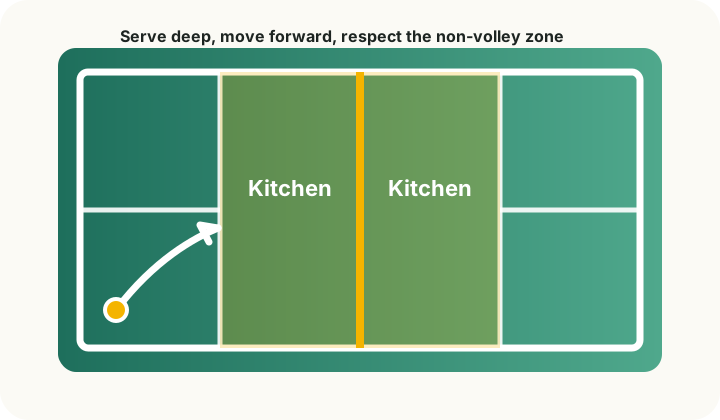
Pickleball is easy to start and surprisingly deep once you play a few games. The rules below cover everything a new player needs for a friendly doubles match: the court, the serve, the two-bounce rule, the non-volley zone, scoring, and the faults that end a rally. Read it once before you play and most of the confusion on court disappears.
The court and equipment
A pickleball court is 20 feet wide and 44 feet long — the same size as a doubles badminton court. A net runs across the middle at 36 inches on the sides and 34 inches in the centre. The most important markings are the two service areas on each side and the non-volley zone, a 7-foot strip on either side of the net usually called "the kitchen." You play with a solid paddle and a perforated plastic ball; outdoor balls are slightly harder with smaller holes, indoor balls are lighter with larger holes.
The serve
The serve starts every rally and has a few firm requirements. It is made underhand, with contact below the waist, and the paddle head must be below the wrist at contact. You serve diagonally, from your right service box to the opponent's right box (and from the left to the left), and the serve must clear the net and the kitchen, landing in the diagonal box. You get one serve attempt — there are no "lets" for serves that clip the net and land in, so play on. Many recreational players also use the legal "drop serve," where you drop the ball and hit it after it bounces; this removes the contact-height rules and is easier for beginners.
The two-bounce rule
This is the rule new players forget most. After the serve, the ball must bounce once on the receiving side before it is returned, and then bounce once on the serving side before that team hits it. In other words, the first two shots of every rally — the return, and the third shot — must be hit off a bounce. Only after those two bounces may either team hit the ball out of the air (a volley). The rule exists to stop the serving team from rushing the net and smashing the return, and it is the reason the "third shot" is such an important, much-practised shot.
The non-volley zone (kitchen)
You may not hit a volley — a ball struck out of the air before it bounces — while any part of your body is touching the kitchen or its line. You also may not be carried into the kitchen by your own momentum right after a volley, even if the ball is already dead. You are allowed to step into the kitchen any time to play a ball that has bounced; you just have to be fully out, with both feet behind the line, before you volley again. Because the kitchen prevents players from standing at the net and putting away every ball, it shapes the whole soft game of dinking. If you want the detail, see our guide to the non-volley zone.
Scoring and the serving sequence
Most recreational and tournament play still uses side-out scoring: you can only score a point when your team is serving, and games are usually played to 11, win by 2. The serving team's score is announced first. In doubles, the call has three numbers — for example "4-2-1" means the serving team has 4, the receiving team has 2, and the server is the first server of the two. Both players on a team get to serve before the serve passes to the opponents, except for the very first service turn of the game, when only one player serves. When your team wins a rally on your serve, you score and the same server switches sides and serves again; when you lose a rally, the serve moves to your partner, and then to the other team.
Faults: how a rally ends
A rally ends in a fault — a point or a side-out — when any of these happen: the ball is hit out of bounds; the ball fails to clear the net; the ball is volleyed from inside the kitchen; the two-bounce rule is broken; or the ball bounces twice on one side before it is returned. The serving team's fault ends their serve; the receiving team's fault gives the serving team a point. Knowing the common faults helps you both avoid giving away easy points and recognise when a point is actually over.
Line calls and starting out
A ball that lands on any line is in, except the serve, which is a fault if it lands in the kitchen or on the kitchen line. In recreational play you call the lines on your own side, and the standard is simple: if you are not sure, the ball is in. Calls should be made promptly and honestly — generous, clear calls keep open play friendly. When you are brand new, the fastest way to get comfortable is to play a few games at half pace, calling the score out loud every rally until the sequence feels automatic.
That is the whole framework. None of these rules is complicated on its own; the only one that consistently trips up beginners is the two-bounce rule, so make a point of letting the first two shots bounce until it becomes a habit.
Common beginner mistakes
- Volleying the return before it bounces and breaking the two-bounce rule.
- Stepping on the kitchen line while hitting a volley.
- Forgetting that only one player serves in the very first service turn of the game.
- Announcing the score in the wrong order (serving team’s score comes first).
Quick checklist
- Serve underhand, below the waist, diagonally into the correct box
- Let the return bounce, then let the third shot bounce
- Keep both feet out of the kitchen before any volley
- Call the score (three numbers in doubles) before every serve
- Win by 2 to 11
Frequently asked
Do I get a second serve like in tennis?
No. You get one serve. If it lands out or in the kitchen it is a fault, and a net-clipping serve that lands in is simply played on.
Can I ever step into the kitchen?
Yes. You can stand or step into the kitchen any time to play a ball that has already bounced. You just cannot volley (hit out of the air) while touching it.
What does a score like "5-3-2" mean?
In doubles the serving team has 5, the receiving team has 3, and the current server is the second server of that team’s turn.
Is pickleball scored to 11 or 15?
Casual and most tournament games go to 11, win by 2. Some medal or longer matches use 15 or 21, but 11 is the default you will see most often.