The kitchen (non-volley zone), fully explained
The most misunderstood seven feet on the court — and how to use them.
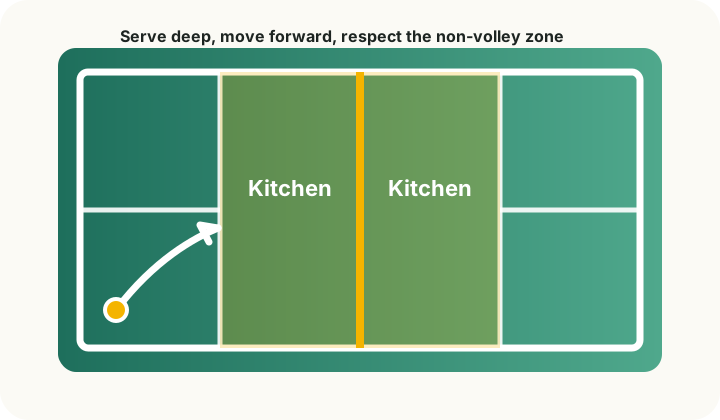
The "kitchen" is the nickname for the non-volley zone (NVZ), and understanding it is the single biggest step from confused beginner to comfortable player. It is the rule that shapes nearly every strategic choice in pickleball, from why you dink to why you cannot simply stand at the net and smash everything. Here is exactly what it is, what you can and cannot do, and how to keep your feet out of trouble.
What the kitchen is
The non-volley zone is the 7-foot area on each side of the net, marked by a line that runs the full width of the court. It includes the line itself. The name "kitchen" has no official meaning — it is just the term everyone uses. The rule attached to it is short: you cannot volley the ball while you are touching the kitchen or its line.
The one rule, stated carefully
A volley is any ball you hit out of the air before it bounces. You may not volley while any part of your body — or anything you are wearing or carrying, including your paddle if it touches the ground — is in contact with the non-volley zone or its line. The restriction is about where you are touching at the moment of the volley, not where the ball is. You can reach over and volley a ball that is above the kitchen, as long as your feet are behind the line and you do not touch the line.
The momentum rule
This is the part that surprises people. If you volley a ball and your own momentum then carries you into the kitchen — or makes you touch the line — it is a fault, even if the ball is already dead and the rally looks over. You are responsible for stopping your own body. In practice this means you should volley from balanced positions, not lunging forward, and you should re-establish your balance before you let your feet drift toward the line.
What you are allowed to do
Plenty. You can step into the kitchen any time to play a ball that has bounced — a dink, a drop that lands short, a ball at your feet. You can stand in the kitchen all day if you want, as long as you are not volleying. The only requirement is that before your next volley, both feet are fully behind the line and you are no longer touching it. Good players step in to take a bounced dink, then push back out to a ready position behind the line so they are legal for the next volley.
Why the rule exists
Without the kitchen, the net would belong to whoever got there first. A tall player could stand on top of the net and smash every ball downward with no way to counter. The non-volley zone pushes both teams back 7 feet, which gives the ball time to be dug up and keeps rallies alive. That is why the soft game — dinking and dropping the ball into the opponents' kitchen — is the heart of higher-level pickleball. To see how this plays out, read our guide to dinking fundamentals.
Footwork: staying out of trouble
Most kitchen faults are footwork errors, not bad shots. A few habits prevent almost all of them. First, set up with your toes a few inches behind the line, not on it, so you have margin. Second, when you reach for a wide dink, step sideways along the line rather than forward into the zone. Third, after any volley near the net, check that you have landed and stopped behind the line before relaxing. Fourth, if a ball pulls you into the kitchen to play a bounce, treat your reset out of the zone as part of the shot — hit, then recover your feet behind the line.
What the kitchen means for strategy
Because you cannot attack from inside the kitchen, both teams end up at the kitchen line in a soft exchange, looking for a ball that pops up high enough to attack from behind the line. This is why patience wins points: you dink and reset, waiting for the opponent to give you a ball above net height that you can step back and volley. Understanding the kitchen turns pickleball from a power game into a chess match played a few inches above the net.
Learn the line, respect the momentum rule, and build clean footwork, and the kitchen stops being a source of mystery faults and becomes the most strategic part of your game.
Common beginner mistakes
- Volleying with a toe on the line.
- Letting momentum carry you into the kitchen after a put-away.
- Stepping forward into the zone for a wide dink instead of sliding sideways.
- Camping out behind the line and never stepping in to take an easy bounced ball.
Quick checklist
- Set your toes a few inches behind the line
- Volley only when both feet are out and stopped
- Slide sideways along the line for wide balls
- Recover your feet behind the line after every net exchange
- Step in freely for any ball that has bounced
Frequently asked
Can I reach over the kitchen to hit a volley?
Yes, as long as your feet stay behind the line and you do not touch it. The rule is about where you are touching, not where the ball is.
If the ball is dead, does it still count as a fault if I fall into the kitchen?
Yes. Under the momentum rule, if your own motion from the volley carries you into the zone or onto the line, it is a fault even if the rally appears over.
Can my paddle land in the kitchen after a volley?
If your paddle touches the non-volley zone as part of the volley motion, it is a fault. Keep your follow-through controlled and balanced.
Why is it called the kitchen?
There is no official reason — it is just the universal nickname for the non-volley zone, possibly borrowed from shuffleboard.