How to self-rate your pickleball level before you have a DUPR
Honest markers to place yourself — and why it is only a starting point.
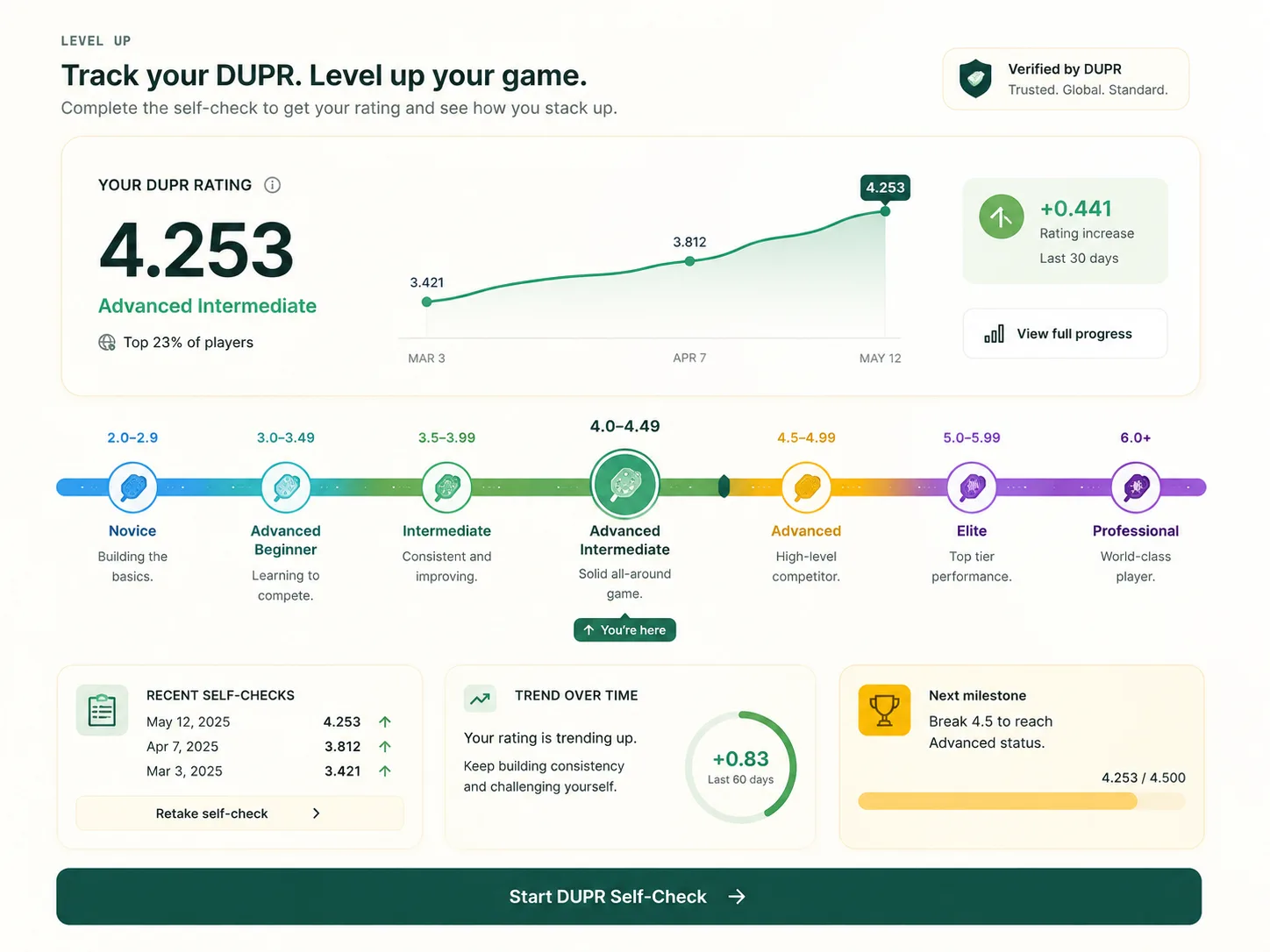
Before you have logged enough matches for a real rating, a self-rating helps you find suitable games and set goals. The catch is that self-rating is rough and easy to get wrong in both directions. Here is how to place yourself honestly from what you actually do on court, and how to confirm it once you start playing rated matches.
Why self-rating is only a starting point
You cannot see yourself play, you remember your best shots more than your misses, and you have no record of how strong your opponents were. That is exactly why a real DUPR rating is calculated from logged match scores instead of opinion. Treat any self-rating — including the result of a quiz — as a friendly estimate to get you started, not a verdict.
What to look at honestly
Skill level is mostly about consistency and decisions, not your single best shot. Ask yourself: can you keep the ball in play through a rally, or do easy balls sail out? Are your serve and return dependable? Can you sustain a gentle dink rally, or does it break down quickly? Do you use a third-shot drop, or only drive? When a ball comes fast, do you reset it or panic? And roughly how many points do you give away with unforced errors? Your honest answers to these say far more about your level than how hard you can hit.
A rough self-rating guide
Use these as general markers, not official cut-offs, and read the matching level pathway pages for detail:
- Around 2.5 — you can rally a little and are still learning the kitchen, serve, and return; rallies break down often.
- Around 3.0 — serve, return, and medium rallies are reliable, you reach the kitchen, but the third-shot drop and dinks are inconsistent under pressure.
- Around 3.5 — dependable drops, low dinks, resets, better positioning, and noticeably fewer unforced errors.
- Around 4.0 — you control pace, mix drives and drops, stay patient at the kitchen, and target deliberately.
Be honest in both directions
Two mistakes are common. Inflating your level leads to lopsided games where you struggle and no one enjoys it. Sandbagging — rating yourself low, especially to win — does the same in reverse and is discouraged everywhere, including at tournaments. The most useful rating is the honest one, because it puts you in competitive games where you actually improve.
Use the self-check, then log matches
To turn this into a concrete estimate, take the DUPR self-check: ten on-court situations where you pick a shot, power, and target, and it estimates a level from your decisions. It is a starting point, not an official number. Once you have a sense of where you sit, the only way to get a true rating is to play and log matches — through a club, league, tournament, or verified recreational play — so your number reflects real results over time.
Common beginner mistakes
- Rating yourself from your best shots instead of your overall consistency.
- Inflating your level into games you cannot compete in.
- Sandbagging a low rating, especially to win.
- Treating a quiz estimate as an official DUPR number.
Quick checklist
- Can you keep the ball in play through a rally?
- Are your serve and return dependable?
- Can you sustain a dink rally and use a third-shot drop?
- Do you reset fast balls instead of panicking?
- Take the self-check, then log matches for a real DUPR
Frequently asked
How accurate is a self-rating?
Only roughly. You remember your best shots, cannot see yourself play, and lack opponent context. Use it as a starting estimate and confirm with logged matches.
What is the difference between self-rating and DUPR?
A self-rating is your own estimate; DUPR is calculated from the scores of real matches you log, on one scale for all players.
Should I rate myself higher to improve faster?
No. Honest games are where you improve. Inflating your level leads to lopsided matches; an accurate rating puts you in competitive ones.
How do I get an official rating?
Create a free DUPR account and get matches logged through a club, league, tournament, or verified recreational play. The more varied matches you log, the more reliable it becomes.