The third-shot drop, explained: why it matters and how to drill it
The shot that lets your team get to the net.
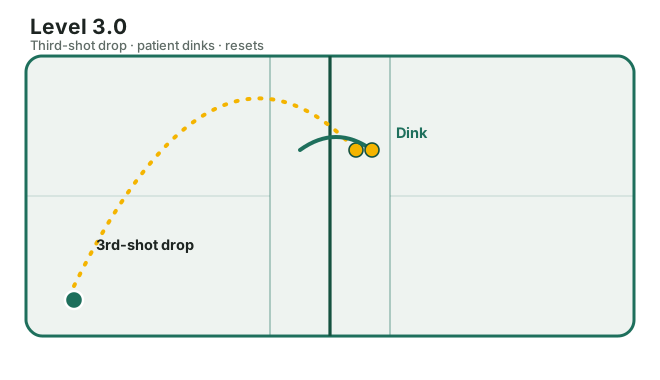
The third-shot drop is the shot that separates players who stay stuck at the baseline from players who get to control the net. It is not flashy, it takes patience to learn, and it is one of the highest-value skills in doubles. Here is what it is, why it matters, how to hit it, and how to practise it without getting discouraged.
What the third-shot drop is
It is the third shot of the rally — the serving team's first shot after the serve and the return — played softly so the ball arcs up and lands gently in the opponents' non-volley zone. Done well it drops over the net with almost no pace, so the opponents standing at the kitchen cannot attack it. The job of the shot is not to win the rally outright; it is to buy your team time to move forward from the baseline to the kitchen line, where points are actually decided.
Why it matters so much
Because of the two-bounce rule, the serving team must let the return bounce before hitting the third shot, which means they start the rally pinned at the baseline while the receiving team is already at the net. If you drive that third shot, a good net team simply blocks it back at your feet and you stay stuck. A soft drop, by contrast, lands unattackable in the kitchen and gives you the two or three seconds you need to walk forward. Once both teams are at the kitchen, the rally resets to even — and that is the whole point of the shot.
The shape of a good drop
A good drop has a high, soft arc. The peak of the arc should be on your side of the net, so the ball is already falling as it crosses — that downward flight is what makes it land short and unattackable. A common mental cue is to picture the ball clearing the net by a foot or two and dying in the kitchen, not skimming the tape on a flat line. Height with softness beats a low, fast drop that the opponents can pick out of the air.
How to hit it
Get low by bending your knees, and contact the ball out in front of your body with a gentle low-to-high lift. The power comes from your legs and a small shoulder push, not from a big arm swing or a flick of the wrist — soft hands are everything. Keep the paddle face slightly open and let the ball sit on the face for a fraction longer than feels natural. Think "lift and follow through toward the target," not "hit." If you are swinging hard, you are doing it wrong.
Drop or drive?
You do not have to drop every third shot. The simple rule: drop when you are pushed deep or the ball is low, and drive when the return sits up high enough to attack. A drive can be a good change-up — especially if the opponents are weak at handling pace or are crowding the line — but the drop is the reliable default that lets you advance. Many intermediate players improve fastest by committing to the drop for a few weeks until it is dependable, then adding the drive as a weapon.
Footwork after the drop
The drop is only half the play; moving in is the other half. After you hit it, take a few controlled steps forward and split-step (a small balanced hop) as the opponents make contact, so you are stable and ready to react. Do not sprint blindly to the kitchen — if your drop is a little high and they attack, you want to be balanced enough to reset the next ball. Advance in stages: drop, move, split, read, move again, until you reach the line.
How to practise it
Drop practice rewards repetition. With a partner, stand at the baseline while they feed from the kitchen, and hit ten drops in a row aiming to land them soft in the kitchen; count how many stay unattackable and try to beat your number. Then add movement: drop, take two steps in, and reset the feed. Solo, you can drop against a wall or into a target (a towel or hoop laid in the kitchen). Fifteen focused minutes a few times a week will do more than hours of game play, because games give you only a handful of third shots each.
The drop feels frustrating at first because soft touch under pressure is genuinely hard. Stick with it. It is the single skill that most reliably moves players from the 3.0 plateau into confident, net-controlling pickleball. Pair it with steady dinking and you have the core of the soft game.
Common beginner mistakes
- Driving every third shot because power feels safer.
- Swinging hard from the baseline instead of lifting low-to-high.
- Gripping tightly, which kills the soft touch.
- Sprinting to the kitchen off-balance instead of advancing in stages.
Quick checklist
- Bend your knees and contact the ball out front
- Lift low-to-high with soft hands
- Arc the peak on your side so the ball falls into the kitchen
- Take controlled steps in and split-step on their contact
- Reset, don’t panic, if a drop pops up
Frequently asked
Is the third-shot drop only for advanced players?
It is most reliable for intermediate and up, but everyone benefits from practising it early. Even an imperfect drop teaches the soft-hands feel the rest of the net game depends on.
My drops keep getting attacked. What is wrong?
They are probably landing too high or too deep. Aim for a higher arc that peaks on your side and dies just over the net inside the kitchen, and relax your grip so the ball does not fly.
Should I ever drive the third shot instead?
Yes, when the return sits up high enough to attack or the opponents struggle with pace. Use the drive as a change-up, but keep the drop as your dependable default.
How far should I move in after dropping?
Advance in stages rather than all at once. Take a few steps, split-step as they hit, read the ball, and keep moving until you reach the kitchen line balanced.