Official DUPR vs club ratings: why they differ
Your club says 3.5, DUPR says 3.2 — here is what is going on.
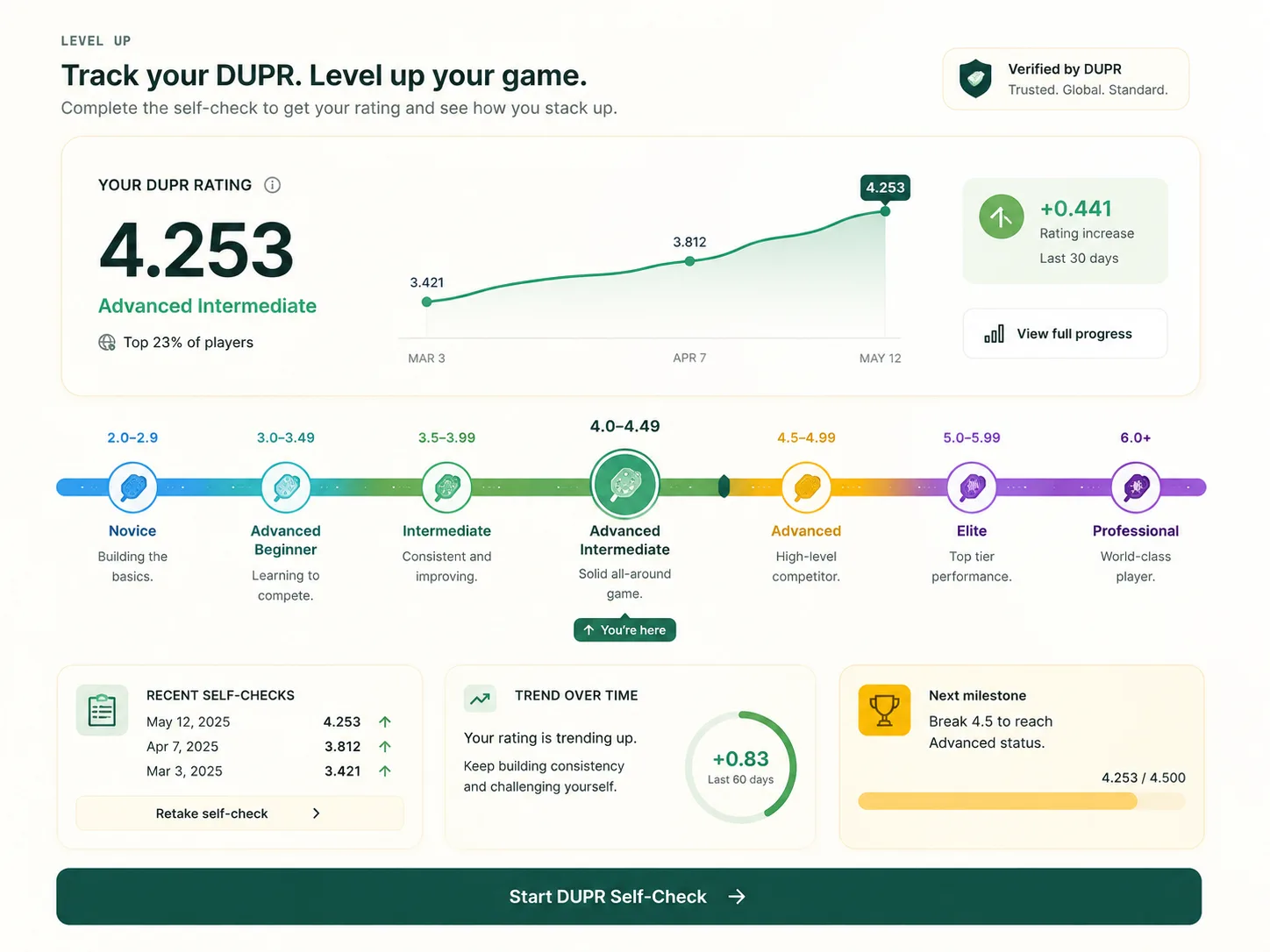
It is common to carry two different numbers: a club or league rating that says one thing and a DUPR that says another. Neither is necessarily "wrong" — they are built differently and answer different questions. Here is why they differ and how to use each one.
What a club or league rating is
Club, league, and ladder ratings are local. They might come from a coach's or director's assessment, a sign-up self-rating, or results within that specific community. Because they are calibrated to one pool of players and are often generous, they work well for organising local play but do not necessarily translate to other clubs or to tournaments.
What DUPR is
DUPR is a universal, algorithmic rating calculated from the scores of logged matches across the whole playing population, on one scale for everyone. That is the point of it: a rating that means the same thing from club to club and city to city. For the full explanation, see what DUPR is.
Why the two diverge
Several things pull them apart. Local pools vary in strength, so a "3.5" at one club is not a "3.5" at another. Self and club ratings tend to drift upward over time and rarely get tested against a wider field. And the methods differ — a human label or a local ladder is not the same as an algorithm weighing opponent strength and score margins. A gap of a few tenths is completely normal, and a DUPR that lands lower is usually the more honest number. If yours feels low, why your DUPR is lower than expected covers the reasons.
Which number to trust for what
Use your club or league rating for the play it was designed for: local leagues, club ladders, and casual round-robins where everyone is on the same local scale. Use DUPR when you need a rating that travels — cross-club play, finding fair games with strangers, and many tournaments that seed or split divisions by DUPR. Picking the right number for the context avoids both mismatched games and unnecessary frustration.
Do not let the gap discourage you
A lower DUPR than your club number does not mean you got worse overnight; it means you are now measured on a wider, more honest scale. Treat it as useful information, keep logging competitive matches, and let your rating reflect your real results over time. If you want a quick estimate of where your decisions sit while you build a logged rating, try the self-check.
Common beginner mistakes
- Assuming a club rating and a DUPR should match exactly.
- Treating a flattering local rating as your true level.
- Using a club rating to enter DUPR-based tournament divisions.
- Feeling discouraged by a normal gap between the two.
Quick checklist
- Know which rating an event or league actually uses
- Use your club rating for local leagues and ladders
- Use DUPR for cross-club play and tournaments
- Expect a few tenths of difference as normal
- Keep logging matches so DUPR reflects real results
Frequently asked
Why is my DUPR lower than my club rating?
Club ratings are local and often generous, while DUPR is a universal scale weighing real results and opponent strength. A lower, more honest DUPR is normal.
Which rating is correct?
Neither is simply "correct" — they answer different questions. Club ratings suit local play; DUPR is the portable rating for cross-club games and tournaments.
Should I use my club rating to enter a tournament?
Only if that event uses skill-level divisions. Many events seed or split by DUPR, so check which rating the tournament actually uses.
Will my DUPR catch up to my club rating?
It reflects your real logged results. If your club rating was generous, the two may simply settle at different points; keep logging competitive matches.