Who takes the middle ball in doubles pickleball?
A simple decision framework for the ball that causes the most partner confusion.
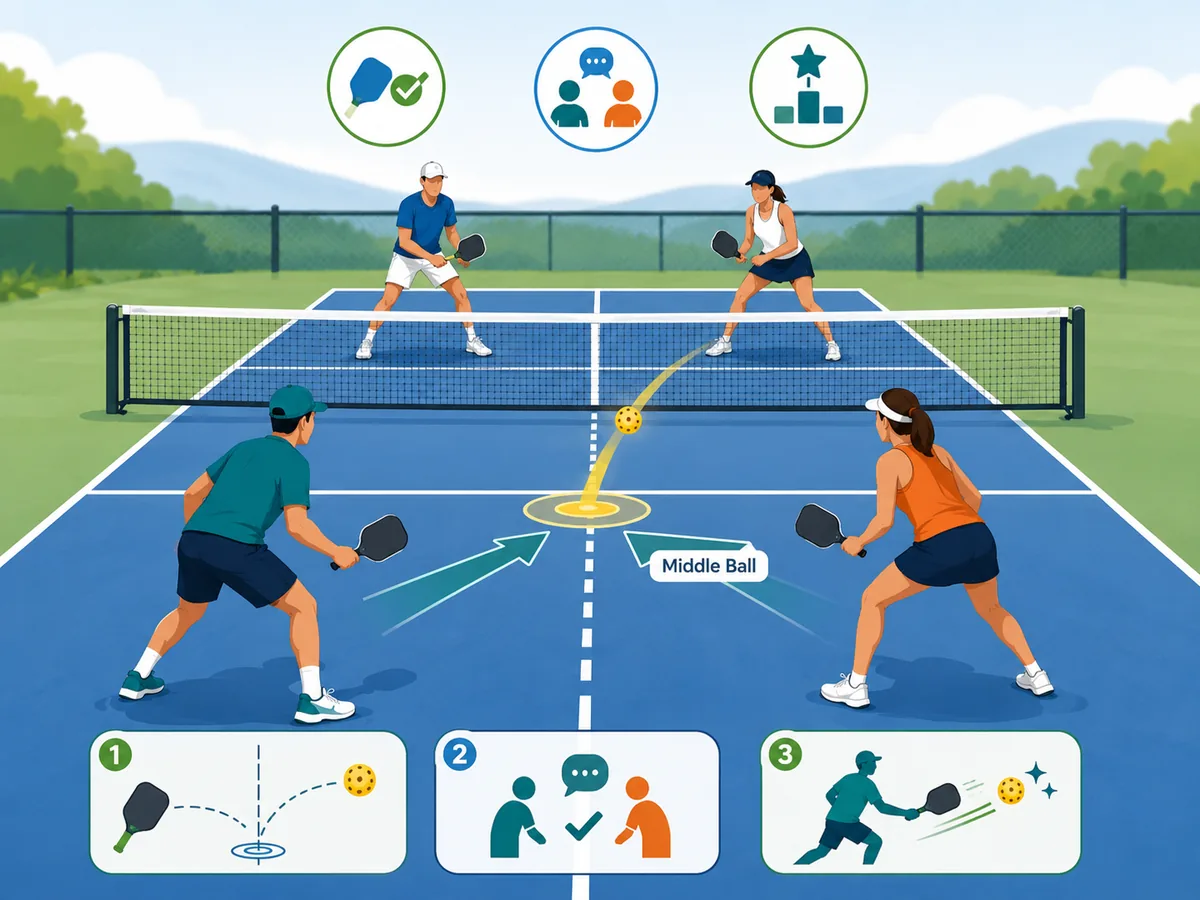
The middle ball creates more partner confusion than almost any other ball in doubles pickleball. Both players think the other person has it, or both swing at the same time. The result is a free point, a paddle clash, or a frustrated conversation after the rally. The solution is not one rigid rule; it is a decision framework that both partners can understand before the point starts.
Forehand usually has priority
In many right-handed partnerships, the player whose forehand is in the middle has first claim on neutral middle balls. The forehand is usually stronger, more stable, and easier to control under pressure. That is why stacking and left-right combinations can matter in competitive play. But forehand priority is not absolute. If the forehand player is moving away, late, or off balance, the better positioned partner should take the ball.
Position beats ownership
The player closer to the ball with a balanced base often has the better play, even if the ball appears to be in the other player's “zone.” Middle coverage should be based on who can hit a controlled shot, not who can barely reach. If one partner is at the kitchen line and the other is still in transition, the kitchen-line player often takes more middle balls because they can see and control the angle earlier.
Momentum matters
If one player is moving through the ball and the other is falling away, the moving player should often take it. This matters especially after wide dinks and crosscourt exchanges. When your partner gets pulled outside the sideline, you should shade toward the middle. That slide is not stealing; it is covering the court your team just opened.
Use short calls
Long explanations do not work during a rally. Use one-word calls: “mine,” “yours,” “go,” or a partner's name. The goal is not to talk on every ball; it is to make ambiguous balls less ambiguous. Many teams also agree before the game: forehand in the middle has priority unless someone calls early.
When in doubt, choose the safer player
If the ball is high and attackable, the player with the cleaner offensive angle should take it. If the ball is low and defensive, the player with the calmer reset should take it. Middle balls are not about ego. They are about choosing the teammate who can make the highest-percentage shot for that exact ball.
For practice, use the DUPR self-check and the skill review criteria to evaluate middle-ball decisions separately from shot execution. Sometimes the shot misses because the wrong player took it.
Common beginner mistakes
- Assuming the same player owns every middle ball.
- Watching a partner get pulled wide without sliding toward the gap.
- Calling too late or using long phrases during fast exchanges.
- Taking a ball only because it is “yours” despite being off balance.
Quick checklist
- Agree on middle forehand priority before the game
- Use one-word calls on ambiguous balls
- Slide middle when your partner is pulled wide
- Let the balanced player take low defensive balls
- Choose the cleaner offensive angle on high balls
Frequently asked
Should the forehand always take the middle?
No. Forehand priority is a useful default, but balance, position, and momentum can override it.
What should partners say?
Use short calls such as mine, yours, go, or a partner name. Say it early.
How do we practice middle balls?
Run crosscourt dink and speed-up drills where one player is pulled wide and the other practices sliding to the middle.