Skills & Drills · Editor's pick
Pickleball 3.0 vs 3.5: what actually changes
The jump is less about hitting harder and more about choosing better.
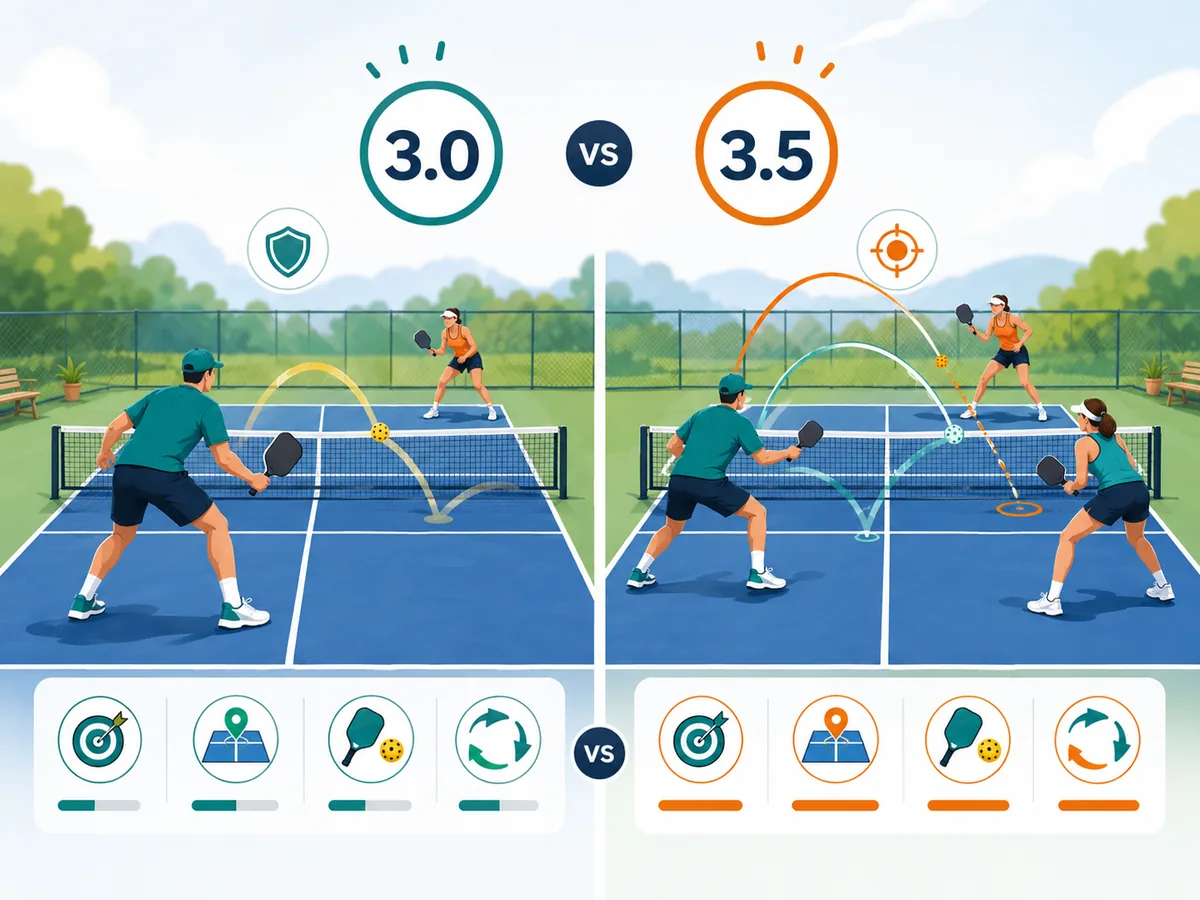
The difference between 3.0 and 3.5 is often misunderstood. Many players think they need more pace, a bigger serve, or a harder drive. Those can help, but the real jump is decision quality. A 3.5 player recognises which balls can be attacked, which balls must be reset, when to move forward, and when not to make the rally harder than it needs to be.
Consistency under mild pressure
At 3.0, a player may look strong in a cooperative drill but lose shape when the rally speeds up. At 3.5, the same basic shots still work under mild pressure. The serve stays in. The return stays deep. Dinks do not need to be perfect, but they clear the net and avoid floating too high. Resets are not automatic, but the player has a plan instead of simply blocking and hoping.
The transition zone becomes intentional
3.0 players often sprint through the transition zone or freeze in it. 3.5 players understand that the middle of the court is a working area. If the ball is low, they split step and reset. If the ball is high, they step through and pressure. If their team is off balance, they buy time rather than forcing an attack. The transition zone is where many 3.5 games are won because one team reaches the kitchen with control.
Attackable versus not attackable
A major 3.5 skill is recognising height. A ball below net height is usually not a ball to crush. A ball above net height, especially in front of your body, may be attackable. Many 3.0 players attack low balls and pop them up; many 3.5 players wait one more ball and attack only when the geometry is favorable. That patience does not look dramatic, but it wins points.
Defense is not just surviving
At 3.5, blocking and resetting become purposeful. Instead of trying to counter every speed-up, the player can absorb pace, drop the ball into the kitchen, or reset crosscourt to change the rally. Defense becomes a way to get back to neutral, not merely a desperate reaction. This is why soft hands matter as much as power.
Doubles discipline
The 3.5 player respects spacing. They do not overrun their partner. They cover the middle when the partner is pulled wide. They know that an okay shot to the right target often beats a great swing to the wrong target. Communication improves, but more importantly, positioning becomes less random.
If you are close to 3.5, record one game and use Picklary's skill review. Ask reviewers to grade decision quality by criteria, not only the final DUPR식 number. The hidden gap between 3.0 and 3.5 is usually revealed by the balls you choose not to attack.
Common beginner mistakes
- Trying to become 3.5 by adding power only.
- Attacking balls below net height.
- Running through the transition zone without a split step.
- Crowding a partner instead of moving as a connected pair.
Quick checklist
- Identify if the ball is above or below net height
- Split step before contact in transition
- Reset low balls instead of forcing attacks
- Cover the middle when your partner is pulled wide
- Measure improvement by better choices, not only winners
Frequently asked
What is the biggest difference between 3.0 and 3.5?
Decision quality: when to attack, reset, move forward, or stay patient.
Do 3.5 players always have a great third shot drop?
No. They make better third shot choices and recover better when the shot is not perfect.
How can I practice the jump?
Play games where you only attack balls above net height and reset everything else. It trains patience and recognition.