Skills & Drills · Editor's pick
Your first 30 days: a practice routine for 2.0–3.0 players
A simple, repeatable plan that builds the skills that matter early.
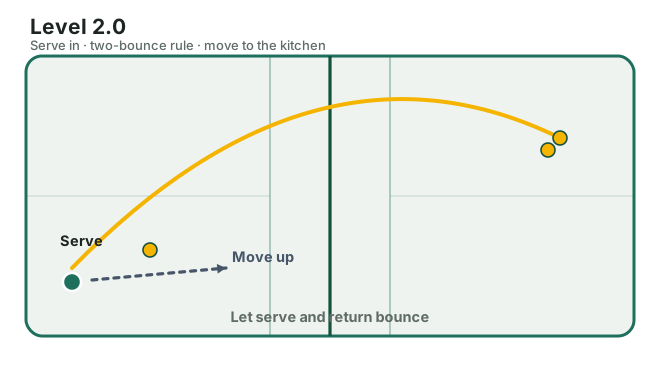
The first month of pickleball decides whether you build good habits or messy ones that take years to fix. You do not need a coach or hours a day — you need a simple, repeatable plan that introduces the right skills in the right order. Here is a four-week routine for a brand-new 2.0 to 3.0 player, built around short, focused sessions you can do a few times a week.
A two-minute warm-up
Start every session the same way: a light jog or some side shuffles, a few arm circles and gentle shoulder rolls, and ten easy dinks or bounces on your paddle to wake up your hands. Warming up protects your shoulder and wrist, and a consistent ritual also tells your brain it is time to focus. Wear proper court shoes from day one — running shoes do not grip for the side-to-side movement, and ankle injuries are the most common way new players lose their first month.
Week 1: rules, serve, return, ready position
Spend the first week getting comfortable with the basics that start every rally. Learn the rules well enough that the two-bounce rule and the kitchen are automatic. Practise a consistent serve to a deep target, and a deep return down the middle followed by moving toward the net. Drill your athletic ready position — knees bent, paddle up and out in front — until it feels natural. The goal this week is consistency and rules, not power.
Week 2: dinking and kitchen footwork
Now build the soft game. Spend most of your practice at the kitchen line dinking — cross-court with a partner, or against a wall on your own — focusing on a relaxed grip and a low-to-high push rather than a swing. Work on your kitchen footwork: stepping in for bounced balls, sliding sideways for wide dinks, and keeping your feet behind the line for volleys. Dinking is the skill most beginners skip and most intermediate players wish they had drilled earlier.
Week 3: the third-shot drop and transition
With dinking underway, add the shot that connects the baseline to the net: the third-shot drop. Practise lifting the ball softly from the baseline into the kitchen, then take a few steps in and split-step. Pair the drop with transition footwork — advancing in stages rather than sprinting — so you learn the drop and the move together, because in a real rally they are one play. Expect this to be frustrating; soft touch under pressure is the hardest part of the game, and it comes with reps.
Week 4: games, strategy, and positioning
In the final week, put it together in real games, but play with intent. Pick one focus per game — "get to the kitchen every rally," or "always stay even with my partner," or "let everything bounce that I should." Apply the positioning basics: move as a pair, take the middle with communication, and race to the kitchen. Playing with a single clear goal each game turns open play into deliberate practice instead of just hitting around.
Track progress and stay realistic
Keep it light but measurable: count your serves in, your dinks in a row, your drops that stay unattackable. Beating your own numbers week to week is far more motivating than worrying about your rating. And be patient — most players feel clumsy for the first few weeks and then improve in sudden jumps. The plateau before a jump is normal, not a sign you are doing it wrong.
A sample week
If you can practise three times a week, a simple split works well: one session on serve and return, one on dinking and kitchen footwork, and one playing games with a single focus. Even 30 to 45 minutes each is plenty in the first month. Quality and consistency beat marathon sessions, and short regular practice is also far kinder to a body that is still adapting to a new sport.
Follow this for a month and you will not be an expert — but you will have clean fundamentals, good habits, and a clear path forward. From here, deepen each skill: dinking, the third-shot drop, and doubles positioning.
Common beginner mistakes
- Chasing power before consistency and soft hands.
- Skipping dinking practice because it feels boring.
- Wearing running shoes instead of court shoes.
- Playing only games and never drilling specific skills.
Quick checklist
- Two-minute warm-up and proper court shoes every session
- Week 1: consistent serve, deep return, ready position
- Week 2: dinking and kitchen footwork
- Week 3: third-shot drop and transition
- Week 4: games with one focus each
Frequently asked
How often should I practise in the first month?
Three short sessions a week of 30–45 minutes is plenty. Consistency beats long, occasional sessions, and short practice is easier on a body adapting to a new sport.
Do I really need court shoes right away?
Yes. Pickleball involves quick side-to-side movement that running shoes are not built for, and ankle injuries are a common way beginners lose their first month.
Why does everyone push dinking so early?
Because the soft game is the foundation of pickleball above the beginner level, and it is the skill most players wish they had drilled from the start instead of just hitting hard.
I feel like I am not improving. Is that normal?
Completely. Most players feel clumsy for a few weeks and then improve in sudden jumps. A plateau before a jump is normal, not a sign you are doing it wrong.