Skills & Drills · Editor's pick
How to move from 2.5 to 3.0 in pickleball
The practical habits that turn rallies from random exchanges into repeatable points.
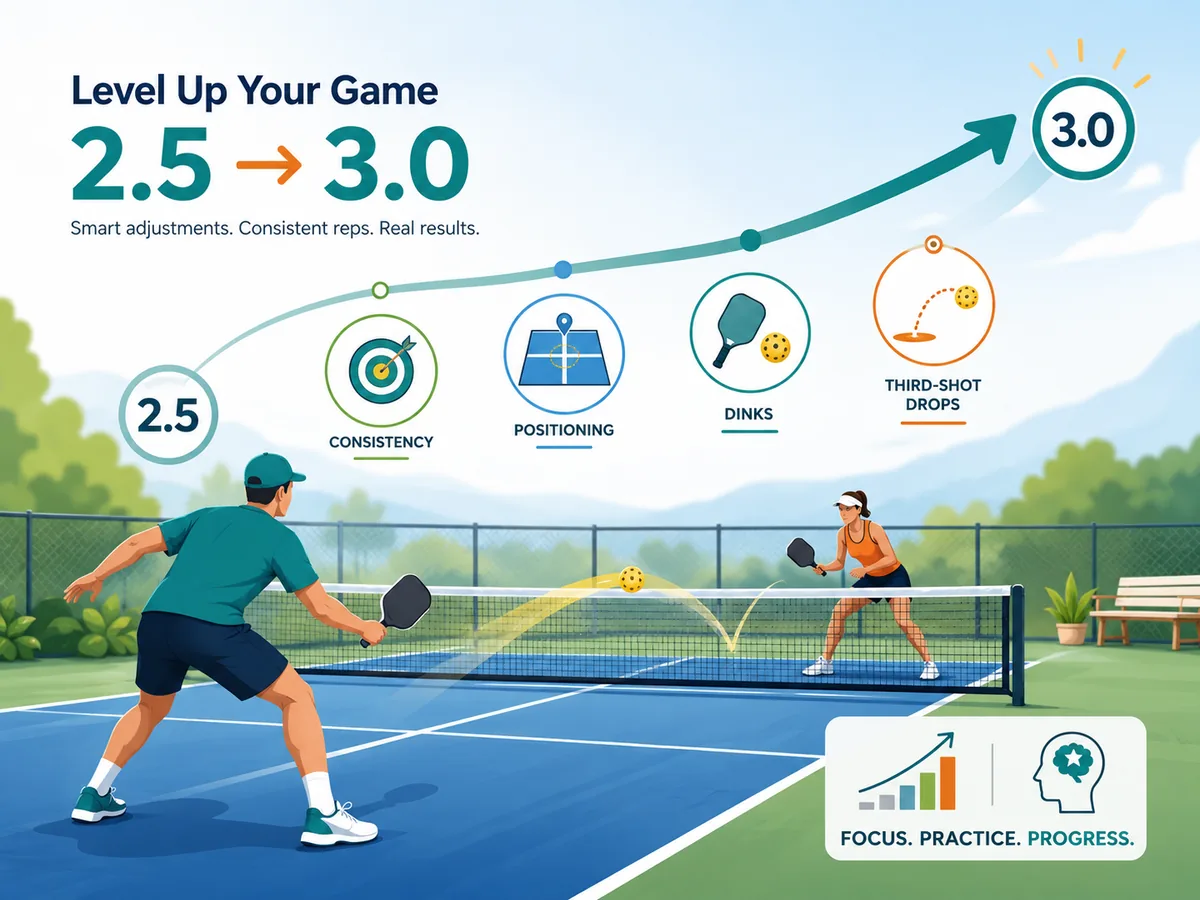
Moving from 2.5 to 3.0 is not about learning a flashy pro shot. It is about becoming predictable in the best way: your serve lands in, your return is deep, your third shot has a plan, and you stop giving away points before the rally really starts. At 2.5, many points end because of missed serves, short returns, rushed drives, and late movement. At 3.0, you still make mistakes, but you can keep the ball in play long enough to let strategy matter.
Start with serve and return depth
The easiest jump in level comes from the first two shots. A reliable deep serve does not need to be fast; it needs to land with enough depth that the receiver has to move or hit from behind the baseline. A deep return does the same thing to the serving team and gives you time to reach the kitchen line. If you can serve in at least nine out of ten times and return deep most of the time, you are already removing the easiest gifts from your game. Use a target: back third of the court, middle lane, and enough height to clear the net safely.
Give the third shot a job
At 2.5, the third shot is often a panic swing. At 3.0, it has a job. If the return is short and high, you may drive with a controlled target. If the return is deep or low, a softer drop or reset gives you a chance to move forward. The goal is not to hit a perfect third shot every time; it is to stop swinging at full speed when the ball is not attackable. A good 3.0 player understands that neutral is better than reckless.
Cut one unforced error category first
Do not try to fix everything in one week. Choose the error that costs you the most points: missed returns, balls hit into the net, balls driven long, or rushed volleys. Track it for three games. If you reduce that one category by half, your level will feel different immediately. Many players improve faster by eliminating one common miss than by adding one new weapon.
Move with your partner
3.0 doubles is where positioning starts to matter. Move forward after a good return. Stay side by side when possible. If your partner is pulled wide, slide toward the middle to cover the gap. If you are both back, do not sprint blindly into the transition zone after a weak shot; earn your way forward with a reset. The goal is to remove empty court that opponents can easily target.
A simple weekly plan
Spend ten minutes on serves, ten on deep returns, fifteen on third shot drop or controlled drive decisions, and fifteen on dink-to-volley transitions. Finish with a game where your only goal is to keep the first four shots in play. That kind of practice is less exciting than smashing, but it builds the foundation that separates 2.5 from 3.0.
Use Picklary's skill review page when you have a short video clip. Ask reviewers to focus on your first four shots, not on a highlight point. The fastest route to 3.0 is usually hidden in the ordinary rallies.
Common beginner mistakes
- Trying to win 3.0 games with power before reducing basic misses.
- Driving every third shot regardless of depth or height.
- Staying back after a good return instead of moving to the kitchen line.
- Practicing random rallies instead of isolating serve, return, and third shot patterns.
Quick checklist
- Serve in at least nine out of ten times
- Aim returns to the back third of the court
- Choose a third shot based on height and depth
- Track one recurring miss for three games
- Move side by side with your partner when possible
Frequently asked
Do I need a perfect third shot drop to be 3.0?
No. You need a safer third shot decision. A controlled drive, a soft reset, or a basic drop can all work when chosen for the right ball.
What should I practice first?
Serve depth, return depth, and fewer unforced errors. Those three areas create the fastest visible improvement.
How do I know I am ready for 3.0 games?
You can keep the first four shots in play, reach the kitchen after returns, and avoid giving away repeated easy points.