From 3.5 to 4.0: the habits you have to fix
The jump is less about new shots and more about unlearning bad ones.
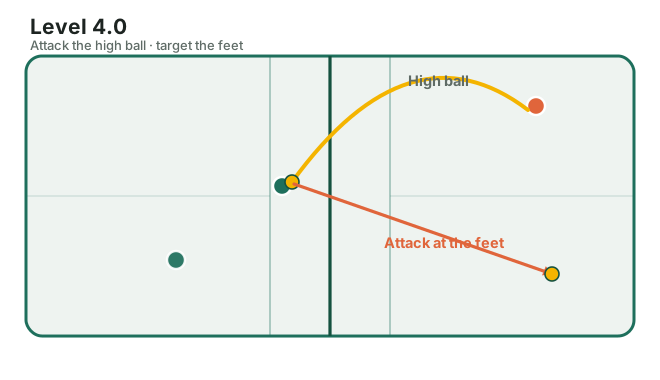
The 3.5-to-4.0 jump frustrates a lot of players because it does not come from learning a flashy new shot. By 3.5 you already own the shots; what holds you back is a handful of habits that quietly give away points. Fix these and 4.0 follows. These are general skill descriptions, not official cut-offs — your real DUPR comes from logged matches — but they are the habits that matter.
Habit 1: impatience in the soft game
The most common 3.5 ceiling is speeding up a ball that was not actually attackable. A 4.0 player has the discipline to keep dinking and resetting until they get a ball clearly above net height, then attacks the right one. Build shot tolerance: be willing to play six, eight, ten dinks and wait for the real opening instead of forcing it on the third.
Habit 2: not resetting under pressure
At 3.5, fast balls often get blocked back too high or popped up. A 4.0 player absorbs pace and drops a hard ball softly back into the kitchen, neutralising the attack. Practise taking pace off with a loose grip and a still face until the reset is automatic; it turns points you used to lose into points you stay in.
Habit 3: predictable, aimless shots
Many 3.5 players hit the same dink and the same return to the same place. A 4.0 player targets on purpose — at the opponents' feet, at the weaker player, to the open middle, behind a player who is leaning. Add intention to every ball: even a defensive dink should be going somewhere specific.
Habit 4: a one-dimensional third shot
Driving every third shot, or dropping every third shot, is readable. A 4.0 player has both a reliable drop and a drive, and chooses based on the ball and the opponents' position. Make the drop your dependable default and use the drive as a genuine change-up, not your only escape from the baseline.
Habit 5: unforced errors and rushed footwork
The single clearest difference at 4.0 is fewer free points given away. Much of that is footwork — getting set and balanced rather than reaching and lunging. Move your feet to the ball, hit from a stable base, and count your unforced errors in real games; halving them does more for your level than any winner.
Habit 6: playing without a plan
4.0 doubles is a team game: communicating, holding the kitchen line together, covering the middle, and stacking if it helps your match-up. Talk to your partner about who takes the middle and which opponent to target. A clear, simple plan beats two players freelancing. Drill these habits, log real matches to track your DUPR, and use the self-check and the Level 4.0 page to see where you are heading.
Common beginner mistakes
- Speeding up balls that were not actually attackable.
- Popping up resets instead of absorbing pace.
- Hitting the same predictable dink and return every time.
- Relying on only a drive or only a drop on the third shot.
Quick checklist
- Wait for a ball above net height before attacking
- Reset fast balls softly into the kitchen
- Aim at feet, the weak player, or the open middle
- Keep a dependable drop plus a drive change-up
- Communicate and hold the kitchen line as a pair
Frequently asked
Why am I stuck at 3.5?
Usually because of habits, not missing shots: speeding up too early, weak resets, predictable targets, and unforced errors. Fixing those unlocks 4.0.
Do I need more power to reach 4.0?
No. Patience, resets, targeting, and fewer errors separate 4.0 from 3.5 far more than power does.
Should I learn to stack?
It can help if it improves your match-up (for example keeping a strong forehand in the middle), but a clear team plan and communication matter more than stacking itself.
Is this an official DUPR description?
No. These are general skill characteristics. A real DUPR rating comes from your logged match results at dupr.com.